Email Newsletter Stats: Open Rate, CTR & ROI Data in 2026
Inboxes are more crowded than ever. Daily emails sent worldwide are projected to reach 392.5 billion in 2026 and 408.2 billion by 2027. That level of volume makes attention harder to earn and even harder to keep.
As a result, newsletters have taken on a different role.
They are no longer just a way to send updates; they now build ongoing engagement and long-term relationships across the subscriber lifecycle.
You can’t rely on assumptions anymore. What works, what is changing, and what drives results now all come back to data.
In this guide, we’ll share the latest email newsletter statistics, along with trends shaping email marketing in 2026 and beyond.
Key Takeaways
- Email still delivers one of the highest returns, but performance now depends on execution
- Subject lines, targeting, and timing decide whether your email gets attention or ignored
- Welcome flows, automation, and re-engagement campaigns keep subscribers active
- AI improves speed and targeting, but results depend on how you use it. Let it handle the system, but keep control of the messaging
Email Open Rate Statistics
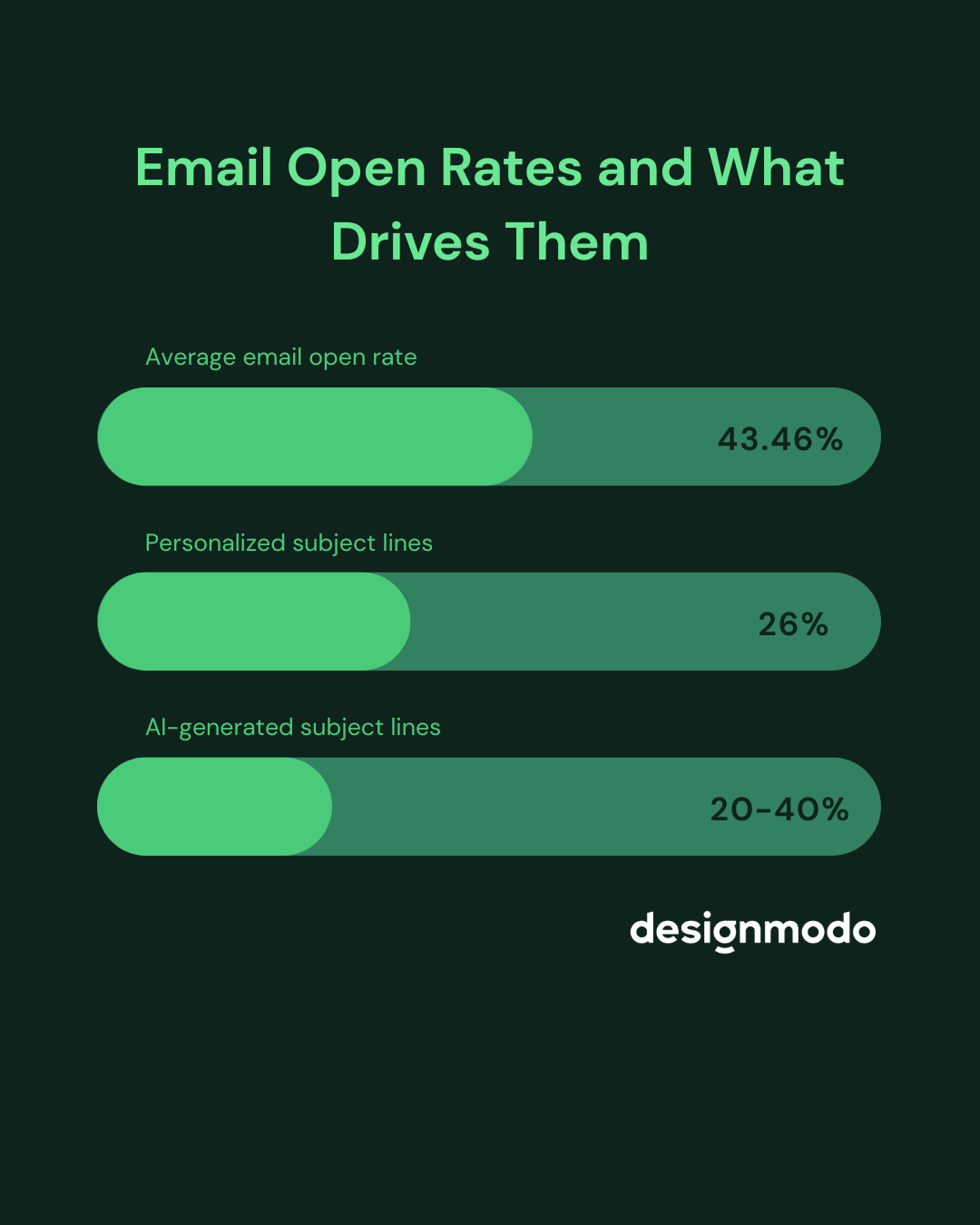
Open rate shows how many people open your email. It is the first signal of performance. If your email is not opened, nothing else gets a chance to work.
With Postcards Email Builder you can create and edit email templates online without any coding skills! Includes more than 100 components to help you create custom emails templates faster than ever before.
Free Email BuilderFree Email TemplatesHere are the latest email open rate statistics:
- Open rate: The average email open rate in 2025 was 43.46% across all campaigns.
- Personalization impact: Personalized subject lines can increase open rates by up to 26%.
- AI subject lines: AI-generated subject lines have shown a 20-40% higher open rate.
What These Email Open Rate Stats Mean
A good open rate falls between 20% and 25%. Campaigns above this range are usually well-targeted and relevant. On the contrary, lower performance often points to issues with timing or messaging.
Here’s how to act on these numbers:
- Write short subject lines (6–10 words) that highlight one clear benefit and place the key message in the first few words
- Remove inactive subscribers and invalid emails regularly so your list stays engaged and your open rate stays accurate
- Group subscribers based on behavior or interests, so each email matches what they actually care about
- Test different send times and frequencies to find when your audience is most likely to open your emails
Email Click-Through Rate (CTR) Statistics
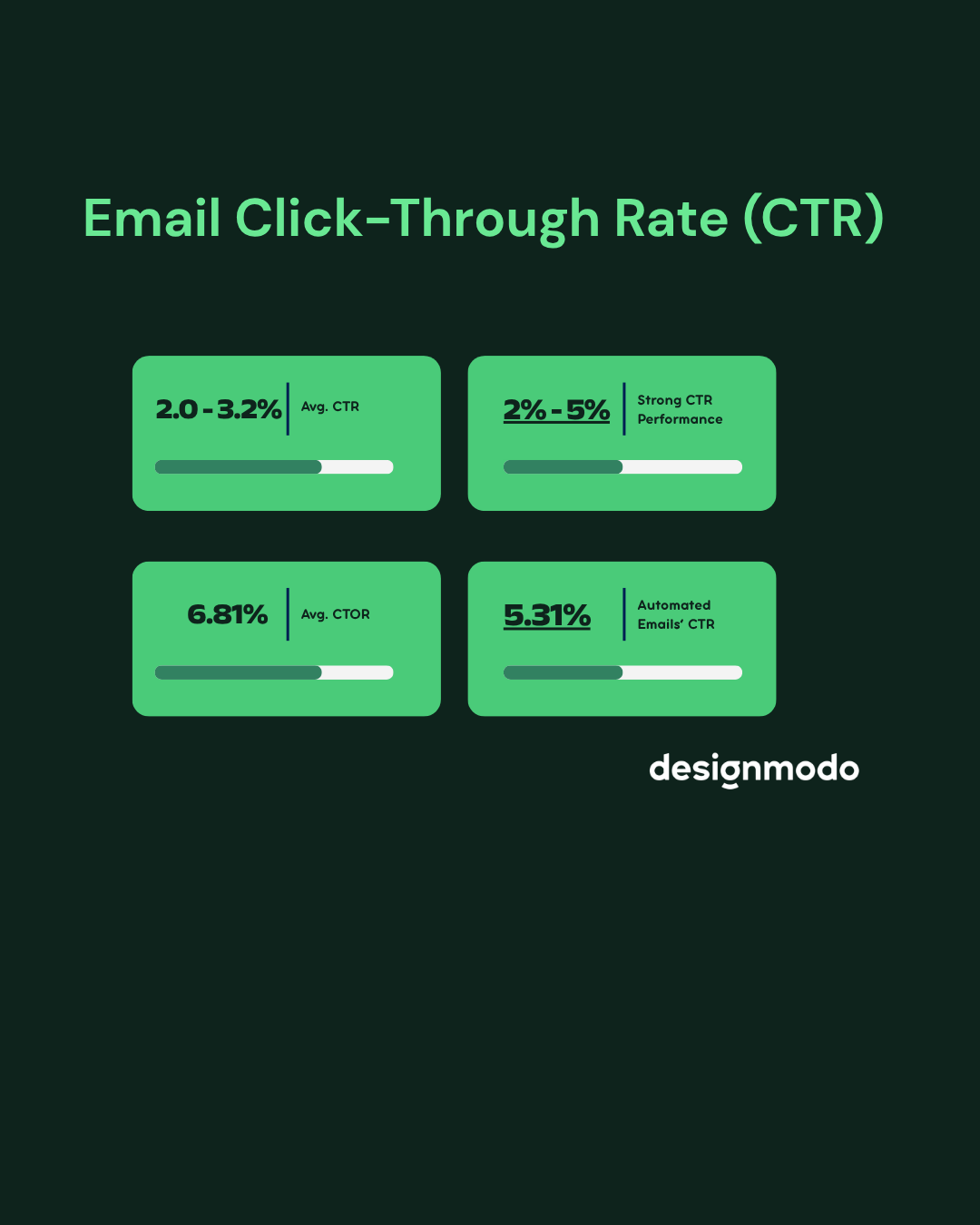
CTR shows how many people clicked after receiving your email. It reflects real engagement. While it is lower than the open rate, it is a stronger signal of action.
Here are the latest email CTR statistics:
- Average CTR: The average email CTR across industries is around 2% to 3.2%.
- Strong performance: A strong CTR typically falls between 2% and 5% across most industries.
- Click-to-open rate (CTOR): The click-to-open rate (CTOR) on average was 6.81% as of 2025. This tells how many openers actually click.
- Automated emails: Automated triggered emails can reach CTRs of 5.31%, much higher than standard campaigns.
What These Email CTR Stats Mean
CTR improves when the email gives one clear reason to click and makes the next step obvious.
Here’s how to improve yours:
- Place your main CTA in the first screen and repeat it once so it stays visible without scrolling
- Focus each email on one goal and remove extra links that compete for attention
- Align your message with what the subscriber signed up for or recently interacted with
- Segment based on behavior or interests, so the content matches intent
- Personalize the email body using past actions or preferences, not just the subject line
- Send behavior-based emails triggered by actions like signups, clicks, or purchases
- Use automation to deliver timely emails that match what the user just did
Email Conversion Rate and ROI Statistics
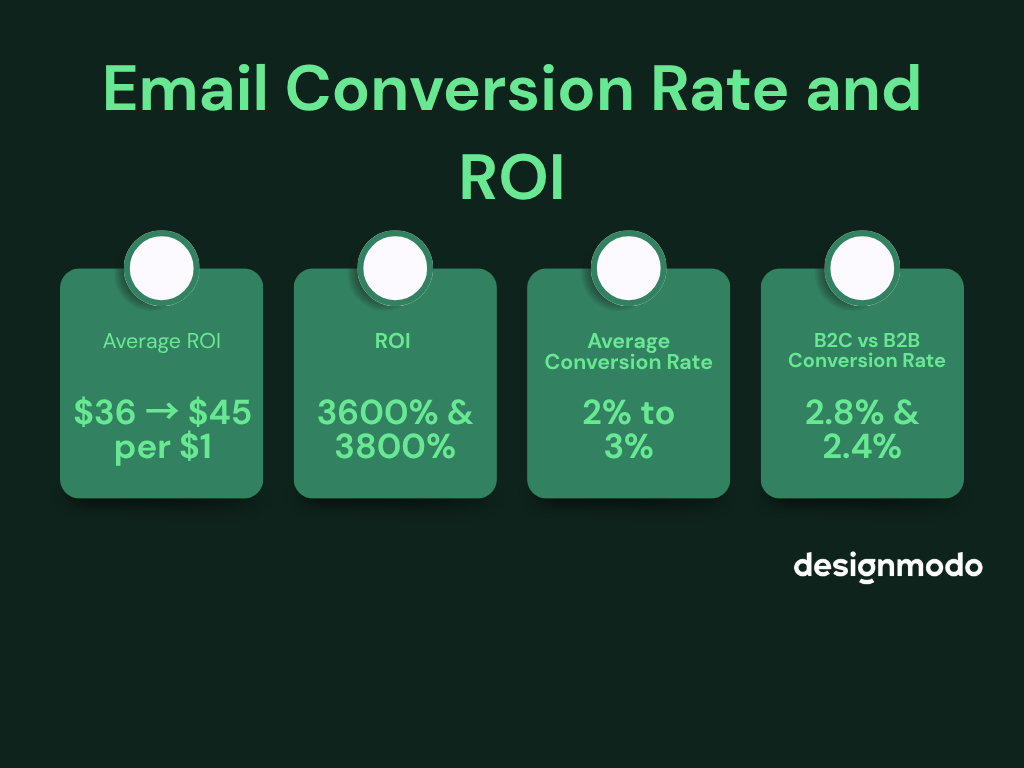
Email continues to be one of the highest-return marketing channels. It performs consistently because brands own the audience and control how and when messages are delivered.
Here are the latest email conversion and ROI statistics:
With Pulsetic you’ll be instantly notified the moment your website, API, or server becomes unavailable. Monitor uptime from multiple global locations and respond to incidents before your users are affected.
Create beautiful status pages in minutes to keep customers informed during outages and build trust with transparent communication.
Start Monitoring for Free- Average ROI: Email marketing delivers around $36 for every $1 spent.
- ROI: Most reports place email ROI between $36 and $42, with some benchmarks reaching up to $45 in 2026.
- ROI percentage: Email marketing ROI typically ranges between 3600% and 3800%.
- Average conversion rate: Good email conversion rates range between 2% to 3% across industries.
- B2C vs B2B: B2C campaigns average around 2.8% conversion rates, while B2B campaigns are closer to 2.4%.
What These Benchmarks Mean
ROI performance improves when emails are tied to user behavior and designed to move subscribers toward a clear action.
Here is how to act on these benchmarks:
- Build your email list through owned channels like signups and lead magnets, so you are not dependent on paid traffic
- Set up lifecycle flows such as welcome, abandoned cart, and re-engagement to convert users at key moments
- Use behavior-based personalization to match offers with what users have viewed or clicked
- Track revenue per email and optimize campaigns based on what drives actual conversions
- Compare email performance against other channels using cost per conversion and total return
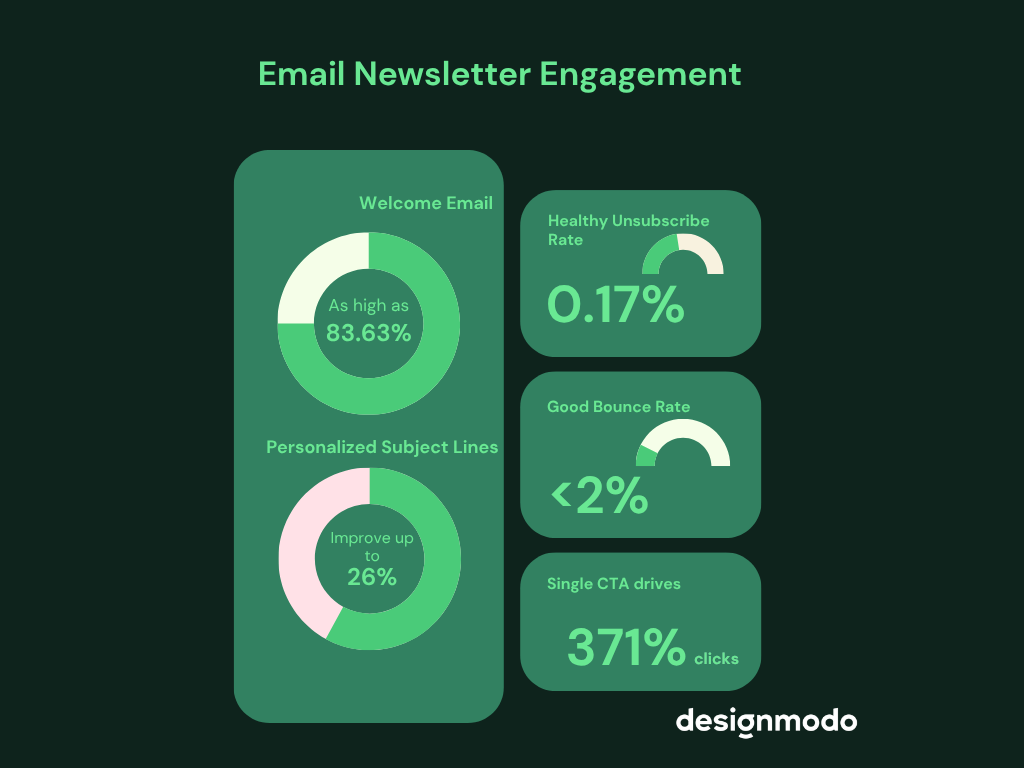
Newsletter performance depends on how subscribers behave over time. Opens and clicks are important, but long-term results come from engagement and retention.
Here are the latest email newsletter engagement statistics:
- Unsubscribe rate: A healthy unsubscribe rate averages around 0.17% for well-maintained lists.
- Bounce rate: Good bounce rates stay below 2% when email lists are clean and valid.
- Welcome email opens: Welcome emails can reach open rates as high as 83.63%, far above regular campaigns.
- Welcome email performance: Welcome emails can generate up to 4x higher open rates and 5x higher click rates than standard newsletters.
- Personalization impact: Newsletters with personalized subject lines can improve engagement by up to 26%.
- Re-engagement recovery: Re-engagement campaigns can recover around 10% of inactive subscribers.
- CTA performance: Emails with a single focused CTA can increase clicks by up to 371%.
- Interactive content: Around 60% of recipients engage more with interactive email content.
How to Achieve Good Email Engagement
Here’s how to act on the benchmarks we mentioned above:
- Set up a welcome sequence that introduces your value clearly and encourages an early action
- Remove inactive subscribers regularly to maintain engagement and deliverability
- Send emails at a steady frequency so you stay visible without overwhelming subscribers
- Run re-engagement campaigns for inactive users before removing them from your list
AI in Email Marketing
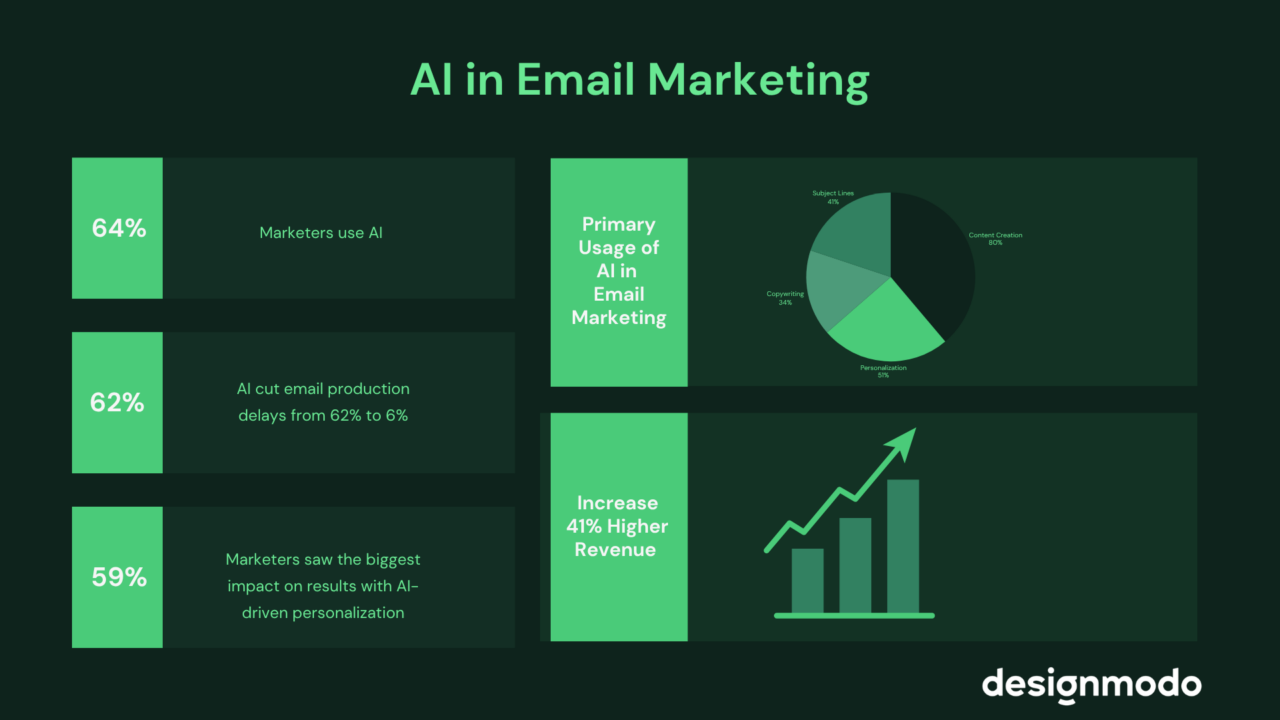
AI is now part of everyday email marketing. It can create content and personalize messages depending on your prompts.
Here are the latest AI in email marketing statistics:
- Adoption rate: Around 64% of marketers use AI in email marketing, with projections reaching up to 97% by 2030.
- Primary use cases: Around 50% of marketers use AI for personalization, while 41% use it for subject lines.
- Content creation: Up to 80% of marketers use AI for content creation across marketing.
- Copywriting usage: Around 34% of email marketers use AI specifically for writing email copy.
- Revenue impact: AI-powered personalization can drive up to 41% higher revenue from email campaigns.
- Production speed: In 2024, 62% of teams needed two weeks or more to create an email, which dropped to around 6% in 2025.
- Performance impact: Nearly 59% of marketers say AI-driven personalization has the biggest effect on results.
Since most teams already use AI in some part of their email workflow, what we have seen is that results improve only when it is used the right way.
Here are some practical ways to use AI in your email newsletters:
- Use AI subject line generators to generate and test multiple subject line variations so you can quickly identify what performs best
- Apply AI-driven personalization based on user behavior to improve relevance and conversions
- Automate repetitive tasks such as segmentation, scheduling, and basic optimization to save time
- Review and refine AI-generated content to maintain quality and brand consistency
Let’s look at a few trends to show where things are heading and what you should pay attention to going forward.
1. AI-Generated Emails Are Becoming Standard
Around 87% of emails are automated, while only 13% are fully human-written. This shows that most teams didn’t sit down and decide, “we’ll switch to AI now.” It just happened. One tool for subject lines, then another for drafts, and suddenly half the workflow is handled.
AI speeds up the whole process, but it does not give perfect outcomes. You still have to step in and make the message feel grounded if you want to build a real connection with the reader.
2. Hyper-Personalization Is Driving Conversions
93% of marketers say personalization improves conversions and data also proves this: around 80% of users are more likely to buy from personalized emails.
Generic emails still get sent. But what’s changing is how specific emails can get. This means don’t stick with just “Hi [Name]”; instead, say “since you looked at this, here’s something related.”
When you use this approach, it’s more likely to convert the right leads.
3. Automation Is Scaling Email Marketing
Around 9 out of 10 marketers want AI to handle email tasks by 2026. And if your email strategy still depends on sending campaigns manually, it’s time to rethink how you work.
AI can take care of repetitive tasks like scheduling, segmentation, and testing. The part that still needs you is the message itself. What you say, how you say it, and why it matters to the reader.
Email newsletter performance comes down to execution. If you want to speed up production without getting stuck in coding, use ready-made templates.
Designmodo gives you a wide range of free email templates that you can customize with its email builder. This way, you can build and send newsletters faster and keep your design consistent.