90+ Email Subject Lines for Sales That Get Replies
Around 47% of people open emails based on the subject line alone, while 69% report emails as spam based only on the subject line. That means one weak line can kill both visibility and trust before your message is even seen.
In this guide, I’ll share proven subject line ideas, simple patterns you can reuse, and practical tips to help you write subject lines people actually open.
For easy access, download the full collection of subject lines and use them whenever you need a quick win
Key Takeaways: Sales email subject lines that get replies are short and written for one person. The best ones name a real problem or ask a question the reader actually wants to answer.
- Keep subject lines around six words and focused on one idea.
- Personalize beyond the name by referencing their role, their company, or something they’re actively working on.
- Match the tone to where the reader is in the conversation.
- Test your subject lines with Designmodo’s Subject Line Tester before sending. It takes seconds and tells you what’s likely to get ignored before it reaches a real inbox.
What Makes a Great Sales Email Subject Line?
A great sales email subject line does one of four things: it’s clear, curious, relevant, or urgent. Most of the best ones do two.
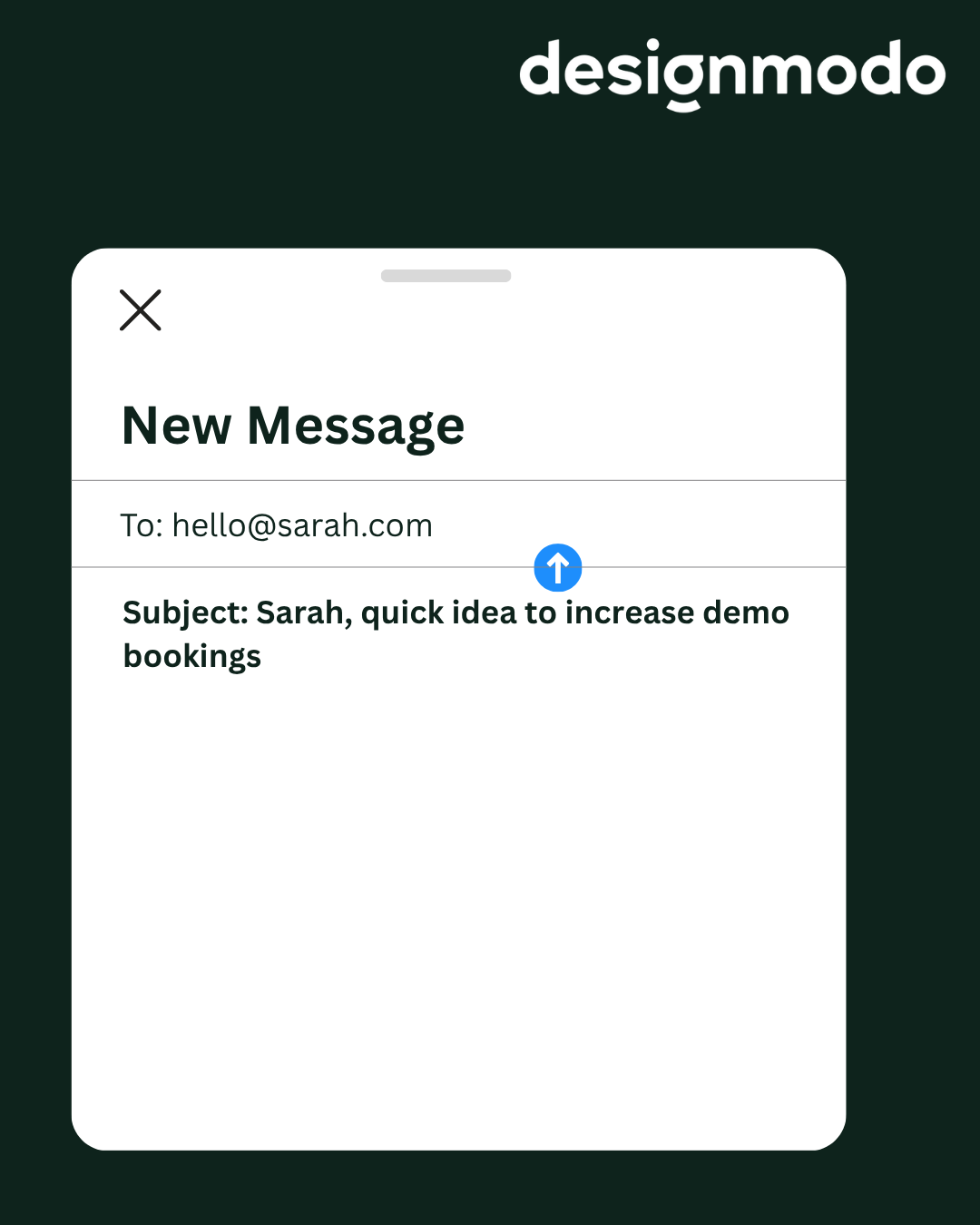
Here’s how to write such subject lines:
With Postcards Email Builder, you can create and edit email templates online without any coding skills! It includes more than 100 components and the AI Suite, which builds and translates full templates from a single prompt.
Free Email BuilderFree Email TemplatesClarity
A clear subject line tells the reader exactly what’s inside without having them to guess.
“3 ways to reduce churn this month” is clear because the reader knows what they’re getting before they open it. A vague line like
“Thought you’d find this interesting” gives them nothing to act on, so they likely won’t open your email.
Curiosity
A curious subject line hints at something without giving it away. As a result, the reader opens to find the answer.
“You’re losing leads here” would make the reader curious because it points to a specific problem without naming it. So the reader wants to know where.
That said, curiosity only works when the email is delivered. If the content doesn’t match the subject, you fail to build trust, and your next email gets ignored before it’s even read.
Relevance
A relevant subject line feels like it was written for that specific person, not a list of thousands. That’s what gets it opened.
“{{FirstName}}, quick thought on your onboarding flow” is a relevant subject line because it uses their name and references something specific to their business. Such personalized subject lines are 26% more likely to be opened.
With Pulsetic you’ll be instantly notified the moment your website, API, or server becomes unavailable. Monitor uptime from multiple global locations and respond to incidents before your users are affected.
Create beautiful status pages in minutes to keep customers informed during outages and build trust with transparent communication.
Start Monitoring for FreeBut a generic line like “Improve your workflow today” could be for anyone, which means it feels like it’s for no one.
Urgency
A subject line with urgency gives the reader a concrete reason to act now rather than later. For example, “Last 2 spots for April onboarding” looks urgent because the limit is specific and believable.
On the contrary, forced urgency like “Act now. Limited time!” does the opposite. It reads as spam and gets ignored. Only real deadlines or real limits create pressure that converts.
Email Subject Line Ideas for Sales Emails (By Category)
These email subject lines are a swipe file you can copy and use right away. Choose one, tweak it for your audience, and test it.
Cold Email Subject Lines
Cold email subject lines get opened when they feel personal and specific, like you wrote it for that one person, not exported it from a CRM.
Here are 20 that do that, with notes on what makes each one good.
1. Personal and direct
{{FirstName}}, quick thought on {{CompanyName}}’s growth
Most cold emails feel like broadcasts, but this one doesn’t. The name and company together signal that you did your homework and that there’s one specific idea inside, not a five-paragraph pitch.
2. Curiosity with context
Came across something interesting about {{CompanyName}}
By reading this line, the reader assumes you found something real, so make sure you did. Open the email with exactly what you found, or this line backfires fast.
3. Help-first angle
{{FirstName}}, this could make things easier for your team
Positioning yourself as helpful rather than selling changes how the email lands. Use it when your offer genuinely reduces work for their team.
4. Fast improvement
A quick way to improve your {{process}}
“Quick” does a lot of work here. It tells the reader this is just one small idea, so the email should deliver exactly that: one idea, clearly explained.
5. Specific focus
Improve your {x} without extra work
“Without extra work” acknowledges that they’re already busy and promises not to add to that. Swap “x” for whatever process is relevant to your reader.
6. Observation-driven
Noticed {x} in your {{campaign/strategy}}
The {x} is intentional here; it forces you to fill in something real before you send an email. A subject line like “Noticed a drop in your email open rates” or “Noticed a gap in your LinkedIn strategy” hits the right notes because it’s specific.
A generic version of this line, where {x} stays vague, does the opposite — it reads like every templated cold email the reader has already ignored.
7. Low-pressure open
{{FirstName}}, does this make sense for you?
It reads like a question between two people mid-conversation. Pair it with a short email that genuinely invites a yes or no.
8. Problem-led
Teams like yours struggle with {{pain point}}
When the pain point is specific and real, the reader thinks: how do they know that? That’s the open. If the pain point is vague, it reads like every other cold email they’ve already ignored.
9. Missed opportunity
You might be missing this in {{area}}
This one points to a gap without naming it. That small tension — what am I missing? — is usually enough to get the click. But the email needs to answer it immediately, otherwise you may lose your readers’ attention.
10. Simple outcome
{{CompanyName}} could improve your {{result}}
Replace {{result}} with something specific they’re already measured on — “reply rates,” “demo bookings,” “trial conversions.” The moment it gets vague like “performance,” “results,” “outcomes”, it stops feeling like it’s about them and starts feeling like a template.
A subject line like “Acme could improve your demo bookings” lands on the desk of the person responsible for exactly that. But a subject line like “Acme could improve performance here” may go in the spam or trash bin.
11. Permission-based
Can I send you a quick idea?
Asking instead of telling changes the dynamic because it’s harder to ignore a question than a statement. So this type of subject email is best when your follow-up is genuinely short and focused on one thing.
12. Small insight
{{FirstName}}, one small idea for your team
“One” sets a low expectation — just one thing — which makes the email feel manageable rather than overwhelming.
13. Helpful nudge
Thought {x} might be useful for {{CompanyName}}
The “x” is where this line either earns the open or loses it. “Thought this case study on reducing churn might be useful for Acme” feels personal.
“Thought this might be useful for Acme” feels like you filled in the company name and called it personalization. Be specific about what “x” is. Is it a resource, an idea, or a finding? Make it clear before you email.
14. Question-led
How are you handling {{process}} right now?
A real question about a real process invites a genuine answer. The more specific the process, the better. For example, “how are you handling onboarding handoffs” beats “how are you handling growth.”
15. Results-driven
Could this increase your {{metric}}?
Replace {{metric}} with something they’re already tracking, such as open rates, booked calls, or churn rate. If it’s a number they care about, the question is hard to scroll past.
16. Activity-based
{{FirstName}}, saw your recent {{launch/update}}
Reference something specific, like a product launch or a funding announcement, because that effort is rare in cold outreach, which is why it stands out.
17. Role-focused
For your {{team/role}} at {{CompanyName}}
A VP of Sales and a Head of Marketing have different problems, so when you personalize the subject line, this signals you know which one you’re talking to.
18. Outcome framing
A better way to reach {{goal}}
Replace {{goal}} with something your audience is actively working toward right now, such as “a better way to hit your Q2 pipeline target” or “a better way to reduce onboarding drop-off.”
The reason this line fails for most people is that they choose a goal that sounds important rather than one that’s actually on the reader’s plate this month.
19. Time-light
{{FirstName}}, quick 2-minute thought
This subject line removes the biggest objection before the email is even opened: I don’t have time for this. But only use it if the email actually takes two minutes — the mismatch kills trust quickly, we already said it.
20. Natural tone
Might be worth a quick look
Most cold subject lines try too hard, but this one doesn’t, and that’s the point. You can use such subject lines when you want the email to feel like a small tip rather than a pitch from a stranger.
Follow-Up Email Subject Lines
A follow-up subject line keeps the conversation alive without making the reader feel chased. Here are a few ready-to-use subject line ideas:
1. Soft check-in
Just wanted to check in, {{FirstName}}
It puts you back on their radar without any pressure attached to it. Keep your email behind it short.
2. Simple reminder
Following up on my last note
It signals that you have something worth returning to and leaves room to add a small update or a piece of value you didn’t include the first time.
3. Open-ended nudge
Any thoughts on {x}?
It asks for almost nothing, just a reaction, which makes it easier to reply to than a question that requires a considered answer.
4. Relevance check
Still something you’re looking into?
This subject line gives the reader an honest out. That respect for their time is exactly what tends to get a straight answer even if the answer is no.
5. Decision trigger
Should I close this for now?
People don’t like loose ends. This line creates a small moment of decision: reply or let it go. And more often than not, that’s enough to get a response. So you should send it after two or three follow-ups with no reply.
6. Light touch
Quick nudge on this
It doesn’t pretend to be anything other than what it is, a reminder. And that honesty keeps it from feeling pushy.
7. Direct follow-up
Wanted to follow up here
This subject line is straightforward and keeps things moving without signaling any urgency or pressure. Sometimes that’s exactly the right tone.
8. Personal check
{{FirstName}}, did you get a chance to see this?
The name makes it feel less automated. And since it’s a simple, human question, it increases your chances of getting a high open rate.
9. Reopen interest
Worth revisiting {x}?
The {x} is what separates this from a generic bump email.
“Worth revisiting the onboarding proposal?” or “Worth revisiting the Q2 timeline?” tells the reader exactly what you’re referring to.
After a few weeks of silence, that specificity also signals that you remember the details of your conversation, not just that they didn’t reply.
10. Final nudge
Last note from me on {x}
“Last note from me on the content strategy proposal” hits differently than a vague sign-off. The reader knows exactly what’s closing, which makes the decision feel real rather than abstract.
That finality is often what prompts a reply because people respond when they sense a specific door closing.
11. Flexible approach
Happy to pick {x} up again anytime
Naming the actual topic turns a generic sign-off into something that feels considered. For example, “Happy to pick the integration discussion up again anytime” tells the reader you remember what you talked about and that the door is open on their terms, not yours.
That’s a better last impression than disappearing or sending one final push they didn’t ask for.
12. Closing loop
Can we close the loop here?
This subject line asks for a clear answer without demanding one. It’s direct without being aggressive, which makes it a good choice when you genuinely need a yes or no to move on.
13. Next step hint
Open to a quick call this week?
This subject line moves the conversation forward. So use it when there’s already been some engagement, like a reply or a previous conversation.
14. Interest check
Still on your radar?
In this subject line, there’s no mention of your previous email and no nudge toward a next step. It’s just a simple question that a colleague might send after a hallway conversation. That’s what makes it disarming.
If the topic is still relevant to them, this line is enough to bring it back to the surface without any of the awkwardness that comes with a more formal follow-up.
15. New angle
Sharing one more idea for you
The word “one” signals you’re adding something specific to your previous pitch. You can use this type of subject line when you genuinely have something new to offer.
16. Timing reset
Better timing to discuss {x} now?
Adding “x” grounds the question in something real, such as “better timing to discuss the SEO audit now?”
Without it, the line feels like a shot in the dark. But with it, the reader immediately knows what you’re referring to and can answer without digging through old emails to remember what you were even talking about.
17. Gentle push
Wanted to bring {x} back up
A subject line like “Wanted to bring the proposal back up” removes any confusion about what you’re referring to. It’s honest without being pushy. There’s no deadline and no pretense that something has changed since your last email.
Personalised Subject Lines
Personalized subject lines get opened because they reflect the reader’s name or something they’re actually working on. That’s a major reason why such lines stand out in an inbox full of lines that could have been sent to anyone.
1. Name + company
{{FirstName}}, idea for {{CompanyName}}
Using both name and company together signals that the email was written for this person specifically. But the idea you’re referencing needs to connect directly to their business, otherwise the personalization feels like a shortcut rather than a genuine effort.
2. Role-focused
For your {{role}} at {{CompanyName}}
This subject line shows you know who you’re addressing.
3. Recent activity
{{FirstName}}, saw your recent {{launch/update}}
Referencing something they actually did recently shows you paid attention before emailing. This effort is rare enough in cold outreach that it gets noticed.
4. Content engagement
Loved your post on {{topic}}
Acknowledging something they wrote or shared is a natural way to open a conversation. But it only works when you follow it with something meaningful, like a question or a related idea. Without that, it reads like flattery with an agenda.
5. Company-specific idea
{{CompanyName}} growth idea
This subject line ties your suggestion to their company from the first word, which makes it harder to dismiss as generic outreach.
But the email behind it needs to deliver an idea specific to their situation.
6. Behavior-based
Noticed you’re working on {{initiative}}
When the initiative is specific, such as “noticed you’re expanding into the European market”, it shows genuine awareness of what they’re focused on right now.
7. Problem + context
{{FirstName}}, about your {{pain point}}
A subject line like “Sarah, about your onboarding drop-off” tells them immediately that the email is relevant to something they’re actually dealing with.
8. Team-specific
Idea for your {{team}} at {{CompanyName}}
This subject line targets a specific group rather than a generic recipient. “Idea for your customer success team at Acme” narrows the focus in a way that feels considered, especially when your idea genuinely applies to how that team operates.
9. Event-based
Following up after {{event/webinar}}
A shared experience, like a conference or a panel, gives you a natural reason to reach out. It adds context that makes the email feel like a continuation rather than a cold approach.
10. Goal-driven
Help you reach {{goal}} faster
Replace “goal” with something they’re actively working toward, like “Help you reach your Q3 pipeline target faster.”
11. Comparison angle
What {{similar company}} is doing differently
It hints at a gap between what they’re doing and what a comparable company is doing, which is hard to ignore if the comparison is credible and the companies are genuinely similar.
12. Product-specific
Quick thought on your {{product}}
This subject line shows you looked at what they actually offer before reaching out. It also tells them the email is about something specific, so they are likely to read it.
13. Timing-based
{{FirstName}}, quick idea for this quarter
It ties the email to a time period they’re already thinking about. Timing an outreach, such as the end of quarter or budget season, to match where they are in their calendar makes the message feel relevant.
14. Location-based
Idea for your {{location}} team
A subject line like “Idea for your London team” adds a layer of specificity that makes the outreach feel tailored.
15. Direct personalization
{{FirstName}}, this stood out to me
This idea is natural and human, but use it only when the email immediately explains what stood out and why. Without that follow-through, it reads like a hook with nothing behind it. But with it, it’s one of the more disarming ways to open a cold email.
Urgency and FOMO Subject Lines
Urgency only works when there’s a real reason behind it. A made-up deadline fools no one because readers have seen enough “limited time offers” to know when something is genuine and when it isn’t.
Here are a few urgent subject lines you can copy and modify depending on your needs, but use these lines only when there’s a real limit on availability.
1. Real deadline
Closing this Friday
A specific day makes the idea concrete. Because you’re being specific, the reader doesn’t have to calculate how much time they have — Friday is Friday. That clarity is what pushes someone from “I’ll think about it” to an actual decision.
2. Limited availability
Only 3 spots left for April
A number is harder to dismiss; that’s why three spots feel real in a way that “limited availability” never does. It also lets the reader picture exactly how close they are to missing out, which is what creates the pull.
3. Final reminder
Final reminder before we wrap this up
It signals that this is the last they’ll hear about it, which carries more weight than a third or fourth follow-up that pretends nothing has been sent before.
4. Time-sensitive offer
Offer ends tonight at 6 PM
An exact time removes all ambiguity. “Soon” and “shortly” give people room to defer, but 6 PM doesn’t. However, use it only when the cut-off is real, because a deadline that quietly extends itself destroys trust for every future email you send.
5. Soft urgency
Still time, but not for long
Hints at a closing window without any pressure in the tone. It suits situations where you want to create some movement without sounding like you’re counting down on them.
6. Closing soon
Wrapping this up tomorrow
It doesn’t announce itself as an urgency line but mentions, almost in passing, that things are closing. That casualness is what keeps it from feeling like a tactic.
7. Last chance
Last chance to book this month
This subject line creates a boundary that feels like a real constraint rather than something you invented to push a decision.
8. Limited window
Open slots for this week only
This one frames urgency around availability instead of pressure. There are slots, they’re open, but only until Friday. That’s a straightforward fact.
9. Final spot
One spot left for this week
This subject line is the most specific version of scarcity. But “one spot” is either true or it isn’t so only use it when it is. When it’s genuine, it creates a small but real sense of competition that moves people faster than any amount of persuasive copy in the email body.
10. Deadline check
Before we close this tomorrow
This is a gentle nudge that’s framed as a reminder. The reader has already heard about the offer, so this subject line only surfaces it one more time before the window shuts.
11. Quick heads-up
Quick heads-up: closing soon
This one is casual enough to feel like something a colleague might send. It keeps the urgency light while still making it clear that the clock is running.
12. Monthly cycle
April onboarding closing soon
Anchoring the deadline to a specific month makes it feel structural. It also fits naturally into how most buyers already think about their schedules and planning cycles.
13. Last call
Last call for this week’s slots
It is short and easy to process at a single glance. The reader understands immediately what’s happening and how much time they have.
14. Reminder tone
Reminder: access closes tomorrow
This type of subject line works best when the reader has already seen the offer before. It doesn’t re-pitch anything; it only highlights the deadline one final time for someone who was already considering it.
15. Final window
Final window to get started this month
It connects timing with the opportunity to begin. In fact, “Get started” implies that acting now means something actually happens, which feels more concrete.
Question-Based Subject Lines
A question-based subject line creates an open loop in the reader’s mind that they instinctively want to close.
Here are a few examples of such subject lines:
1. Problem-focused question
Are you still struggling to convert leads?
When the problem is real and specific to the reader, this line stops the scroll. “Still” is doing quiet work here. It implies you’ve been paying attention, that this isn’t a new observation. If the problem doesn’t apply to them, they’ll ignore it. If it does, they’ll want to know what you found.
2. Soft invite
Open to a quick idea?
This is a simple question that’s genuinely easy to say yes to; it asks for almost nothing. But make sure to keep the email behind it just as light.
3. Relevance check
Is this something you’re working on right now?
It lets the reader self-select in or out immediately. That respect for their time tends to generate more honest replies, including the ones that say NO, which is more helpful than no response.
4. Curiosity-led
What’s holding back your email conversions?
It asks a question the reader probably already has an answer to, and suddenly, they’re thinking about it before the email is even open. That internal pause creates the pull.
5. Direct engagement
Can I share {{x}} that might help?
This subject line asks for permission, which makes the email feel collaborative. But when you use this, make sure to share such content in the email that genuinely helps. Otherwise, the question-based subject line would feel manipulative.
6. Process-based
How are you handling {{x}} today?
This is specific enough to feel relevant to daily work. But if you add a vague answer to a specific question in your email, it is worse than not asking at all.
7. Outcome-focused
Could this improve your open rates?
The “this” here creates enough curiosity to get the reader to open, so once they do, they’d expect the email to answer the questions in the first two paragraphs, not the fifth.
8. Timing check
Is now a good time to revisit {{x}}?
This subject line acknowledges that the first email might have arrived at the wrong moment without making the reader feel bad for not replying. It also gives them an easy way back into the conversation on their own terms.
9. Awareness trigger
Are you seeing this drop in replies, too?
“Too” is the key word here. It positions you as someone experiencing the same thing, not someone selling a solution to a problem they’ve never had. It builds common ground before the email even opens.
10. Light curiosity
Worth exploring {{x}} further?
It doesn’t demand much — just a yes or a no — which makes it one of the easier lines to reply to in a busy inbox.
11. Personal question
{{FirstName}}, have you tried this approach?
The name makes it feel direct, and the question implies you have a specific approach in mind, so the email needs to get to it quickly.
12. Priority check
Is improving {{x}} a focus right now?
This subject line asks about priorities. Someone might be interested in improving conversions but has three other things ahead of it this quarter, so in such cases, this line surfaces that idea quickly and saves both sides time.
13. Subtle challenge
What if you could double your {{x}}?
This type of line introduces a possibility without making a claim. As a result, the reader imagines it, which is more persuasive than being told directly.
14. Decision prompt
Should we take a closer look at this?
“We” makes it collaborative. It suggests you’re both evaluating something together, not that you’re trying to close a deal. You can use such subject lines when there’s already been some back and forth.
15. Simple opener
Quick question for you
After reading this, the reader expects one short question, so the email should deliver exactly that. If it opens into a three-paragraph pitch, the subject line becomes a lie.
Pain Point-Focused Subject Lines
Pain point subject lines name something the reader is already dealing with. The ones that drive open are helpful and direct, but never negative or aggressive.
Here are a few examples:
1. Direct problem callout
Struggling to get replies from your outreach?
This subject line names a frustration that most people in sales deal with at some point. Replace “replies” and “outreach” with what you want to discuss.
You can use this subject line when reaching out to someone whose role involves cold outreach, like SDRs, account executives, and founders doing their own prospecting. If the problem applies to them, the line is almost impossible to scroll past.
2. Loss-focused
You might be losing leads here
It points to leads quietly dropping off without specifying where, and that vagueness is intentional here. In fact, it makes the reader think about where their leads are actually dropping off.
You can use this when your email identifies a specific leak in their pipeline and gets straight to it.
3. Friction point
Your follow-ups are taking too long
Rather than pointing to a results problem, this one speaks to a process problem. It’s a good fit when you’re reaching out to teams managing high volumes of outreach manually.
4. Performance gap
Open rates stuck below 15%?
A specific number gives the reader a benchmark to measure themselves against. Use it when you know the industry average and your reader is likely falling below it. If they’re above 15%, they’ll scroll past. If they’re not, they’ll want to know what’s inside.
5. Repeated issue
Why your emails keep getting ignored
“Keep” is doing the real work here. You can try this format when addressing a systemic issue rather than a one-off problem.
There’s a gap in your sales emails
It hints at something being off without naming it. The reader’s natural reaction after reading this would be: what gap? That small tension is enough to get the open.
7. Cost angle
This could be costing you deals
Connecting a process problem to a real business consequence is what gives this line its pull. Use it when you can point to something concrete in your audience’s approach that’s likely causing lost opportunities.
8. Overload problem
Too many leads, not enough conversions?
This one speaks to a specific kind of frustration — being busy without seeing results. It’s most relevant for sales teams with a full pipeline but a conversion rate that isn’t keeping up.
9. Efficiency issue
Spending hours on emails with little return?
Instead of pointing to a missed result, this line names wasted effort, which resonates differently. It tends to connect more with individual contributors who feel the time cost of their outreach acutely.
10. Missed opportunity
You’re missing easy wins in your pipeline
“Easy” separates this from a generic missed opportunity line. It suggests the fixes aren’t complicated; you’re just overlooking them.
11. Common mistake
Most teams get this wrong in cold emails
After reading this, the reader wonders: are we doing this, too? You can use such subject lines when the mistake is genuinely common and your email names it clearly.
12. Slow growth
Growth slowing down this quarter?
This speaks to the main concern of most decision-makers. It’s a natural fit when you’re reaching out to founders, heads of revenue, or anyone with a number to hit, as long as your email connects directly to moving that number.
13. Process breakdown
Where your outreach process fails
It implies you’ve looked at how outreach typically works and identified where things go wrong in your audience’s process.
14. Missed responses
Leads opening but not replying?
Anyone running email outreach will recognize this scenario immediately because your subject line is talking about being seen and still not hearing back, which is its own particular frustration.
15. Fix-focused problem
Fixing {{x}} in your emails
Replace {{x}} with something specific, such as “fixing low reply rates,” as this frames both the problem and the intent in one line.
The reader knows immediately what the email is about and what it’s trying to help them do.
How to Write High-Converting Sales Subject Lines
To write a high-converting sales subject line, follow this structure:
[Personalization] + [Outcome or Problem] + [Curiosity or Action]
You don’t need all three parts every time; two done well is enough.
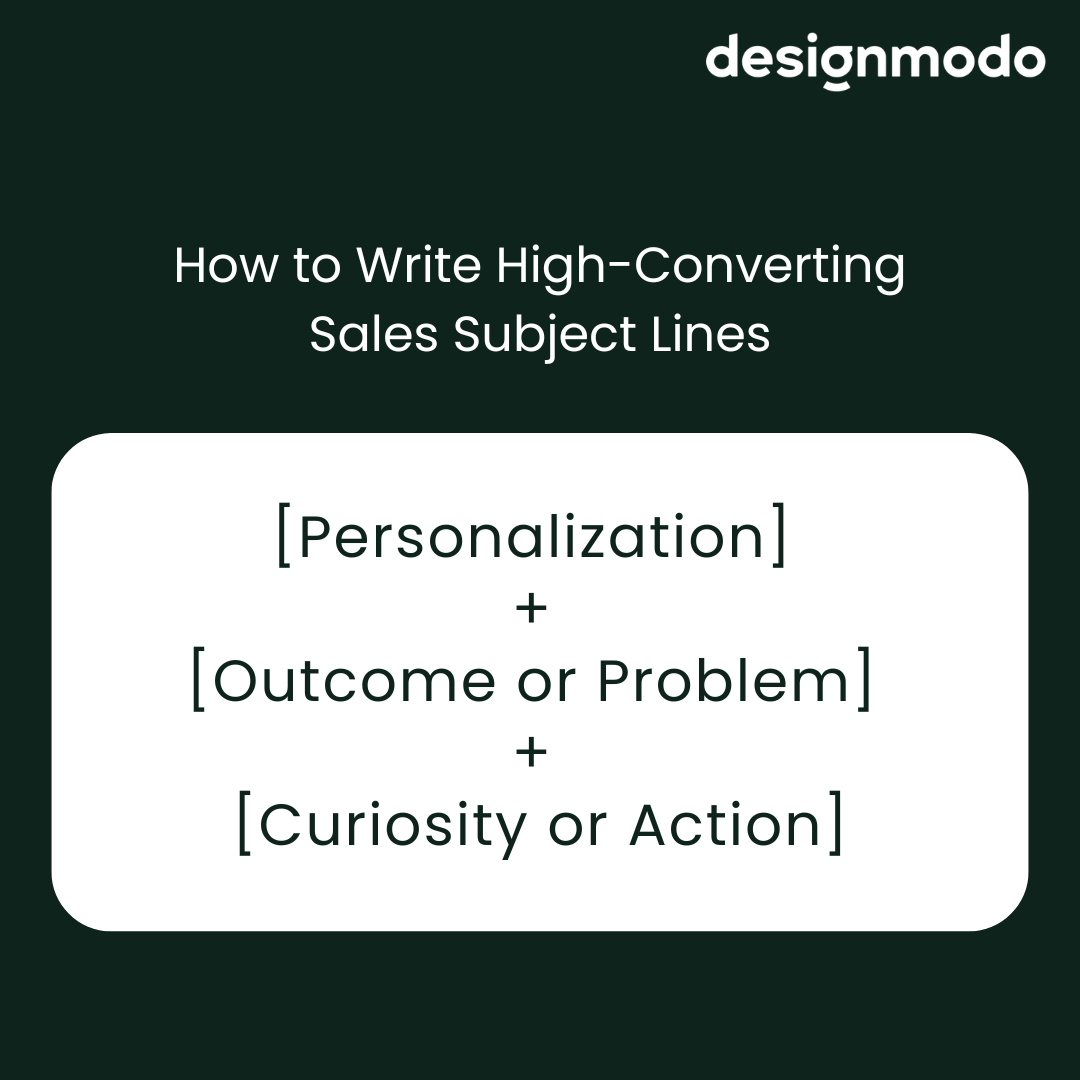
Here’s what that could look like:
- Personalization + outcome structure: Sarah, quick idea to increase demo bookings
- Problem + curiosity structure: Low reply rates? Try this
- Outcome + action structure: Can this improve your pipeline?
Bonus Tips for Writing Effective Subject Lines
A few things that separate lines that get opened from ones that get ignored:
- Keep it under six words: The average subject line is around six words, and anything longer gets cut off on mobile or takes too long to scan.
- Be clear before being clever: People don’t stop to decode subject lines. If it doesn’t make sense at a glance, it gets skipped.
- Use numbers and specifics: A specific number or result gives the reader something concrete to hold onto.
- Avoid spam triggers. ALL CAPS, excessive exclamation marks, and phrases like “Buy now” or “Free offer” kill trust before the email is even opened.
- Make it feel personal. The closer the subject line is to the reader’s actual situation — their name, their company, their role, their current challenge — the harder it is to ignore.
Use an AI Subject Line Generator for Your Sales Emails
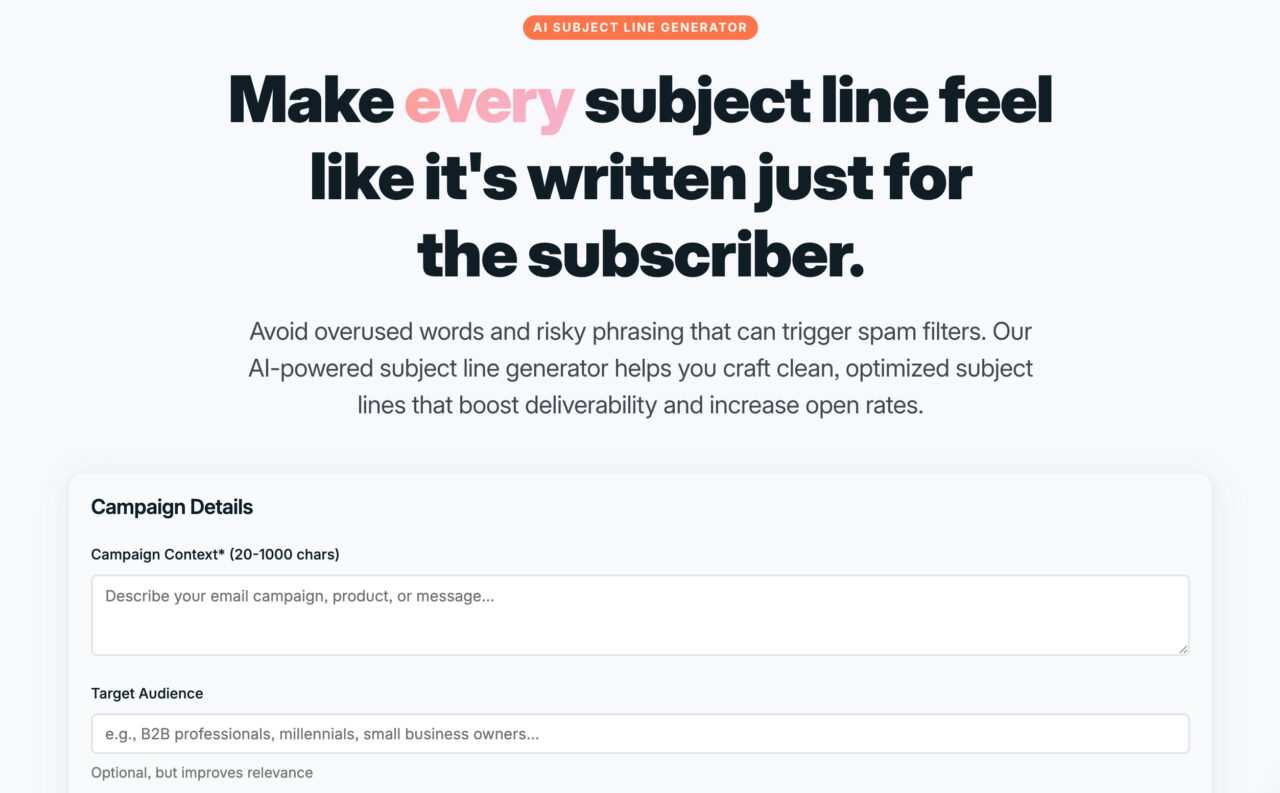
Designmodo’s AI Subject Line Generator gives you multiple angles in seconds, which is way better than starting with a blank page. It can generate curiosity-driven, benefit-focused, or any other type of subject line ideas.
Here’s how to use it:
- In the “Campaign Context” box, describe what your email is about; something like “cold email for SaaS founders about improving demo bookings.”
- Fill in your target audience, campaign type, audience stage, tone, and intent to help the tool generate lines that actually fit your message.
- Adjust the preferred length, capitalization style, keywords to include, and any words you want to avoid.
- Check the “Include emojis in subject lines” box if you want emojis in your subject lines.
- Click the “Generate Subject Lines” button and let the tool do its work.
- Go through the results and choose the subject line that comes closest to what you need and adjust it for the specific person you’re emailing.
Note: The output is a starting point, not a final answer. Take the idea that comes closest and shape it around what you know about the person you’re emailing.