Email Marketing for Financial Advisors: Build Trust to Win High-Value Clients
Email marketing for financial advisors is a direct, compliant channel for sending newsletters to clients and prospects for building trust and driving bookings. Designmodo Postcards let advisors design these branded emails without code.
So if you want to send emails that get opened and booked against, this guide walks you through what to send, when to send, and how to design such emails.
Why Email Marketing Is Important for Financial Advisors
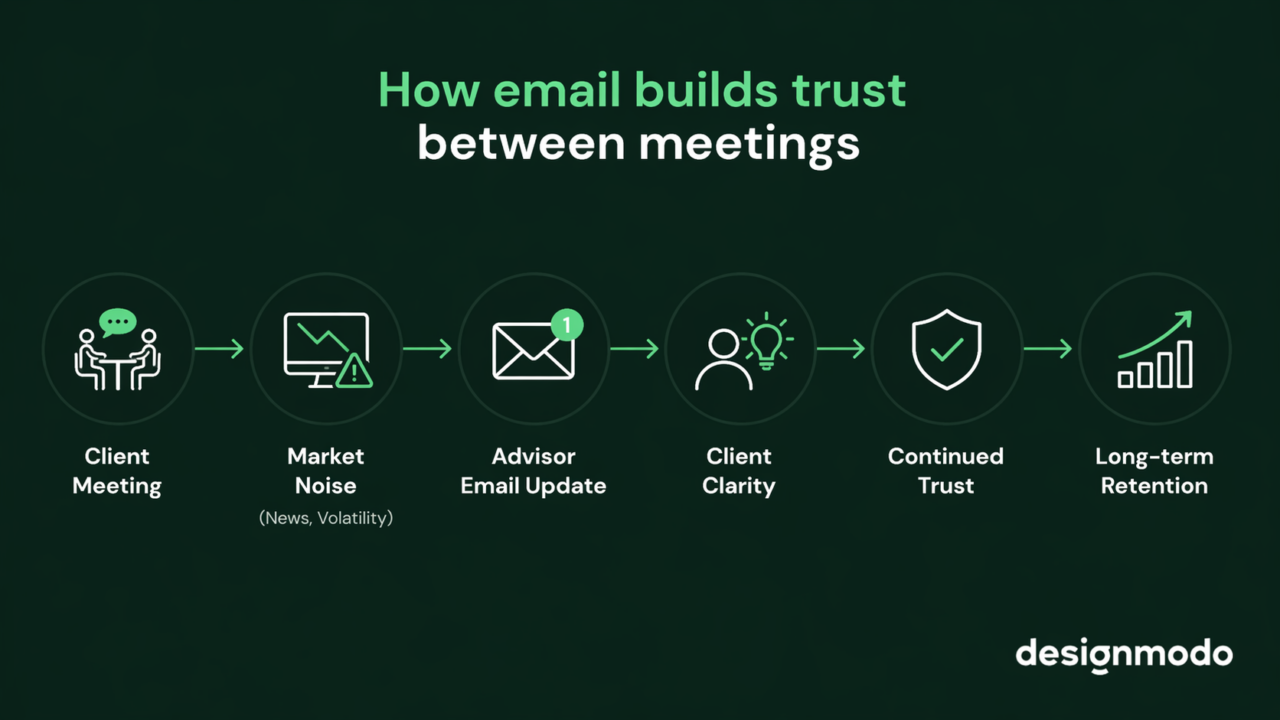
Email marketing builds trust over time and keeps client relationships active between meetings, which leads to higher retention and more long-term revenue.
As a financial advisor, you give guidance during meetings. After that, clients go back to daily noise. News headlines, market drops, and opinions from others start to shape their thinking.
This is where email plays a role.
A short update that explains what changed and what it means for their portfolio reminds them of your strategy. It brings their focus back to the plan you built together.
With Postcards Email Builder, you can create and edit email templates online without any coding skills! It includes more than 100 components and the AI Suite, which builds and translates full templates from a single prompt.
Free Email BuilderFree Email TemplatesThat repeated reinforcement is what builds trust.
When clients see consistent explanations from you, they stop reacting to every market shift. Instead, they recall your reasoning and stay aligned with it.
This also keeps relationships active.
Without communication, clients feel disconnected from their own financial plan. They may not say it, but uncertainty builds.
When you send regular updates, even simple ones, clients stay aware of what is happening. They feel involved, which makes them more confident and less likely to question your decisions.
Over time, this changes behavior.
Clients who feel informed do not panic during volatility. They stay invested and trust the process. And that stability is what leads to long-term retention and growth.
Best Practices For Financial Emails
Financial emails work best when they are easy to read and feel relevant to the person receiving them. Here are some tips to write such emails:
With Pulsetic you’ll be instantly notified the moment your website, API, or server becomes unavailable. Monitor uptime from multiple global locations and respond to incidents before your users are affected.
Create beautiful status pages in minutes to keep customers informed during outages and build trust with transparent communication.
Start Monitoring for Free- Write the way you speak in a client meeting and explain any complex terms in simple words.
- Decide the purpose before you write, and explain one idea clearly instead of covering multiple topics.
- Match the content to the client’s goals and stage, so the message feels relevant because emails with tailored subject lines see 46% higher open rates.
- Send different emails based on whether someone is an active client or still evaluating you.
- State what the email is about so the reader knows what to expect before opening it.
- Track what gets opened or clicked and adjust your email copy based on that.
- Keep subject lines under 50 characters and lead with the benefit or the specific topic because 47% people open emails based only on the subject line.
💡Tip: Use Designmodo’s FREE Subject Line Generator and Subject Line Tester to get ideas and check how well your subject lines might perform before sending.
How Often Should Financial Advisors Send Emails?
Send one to four emails per month, with the exact number depending on the type of list and the type of email.
A good baseline looks like this:
- Newsletter to your full list: Once or twice a month
- Nurture sequence to new prospects: Four to five emails spaced over two to three weeks, then they move to your regular newsletter
- Promotional or offer emails: Only around real moments such as tax deadlines, end of year, or open enrollment windows, usually four to six times a year, total
- Client-only updates: Whenever market conditions or regulatory changes genuinely affect their plan
The mistake most advisors make is inconsistency (not frequency).
A monthly newsletter that actually arrives every month beats a weekly newsletter that shows up three times and then disappears for two months. So decide on a cadence you can sustain through tax season and vacation, and hold it.
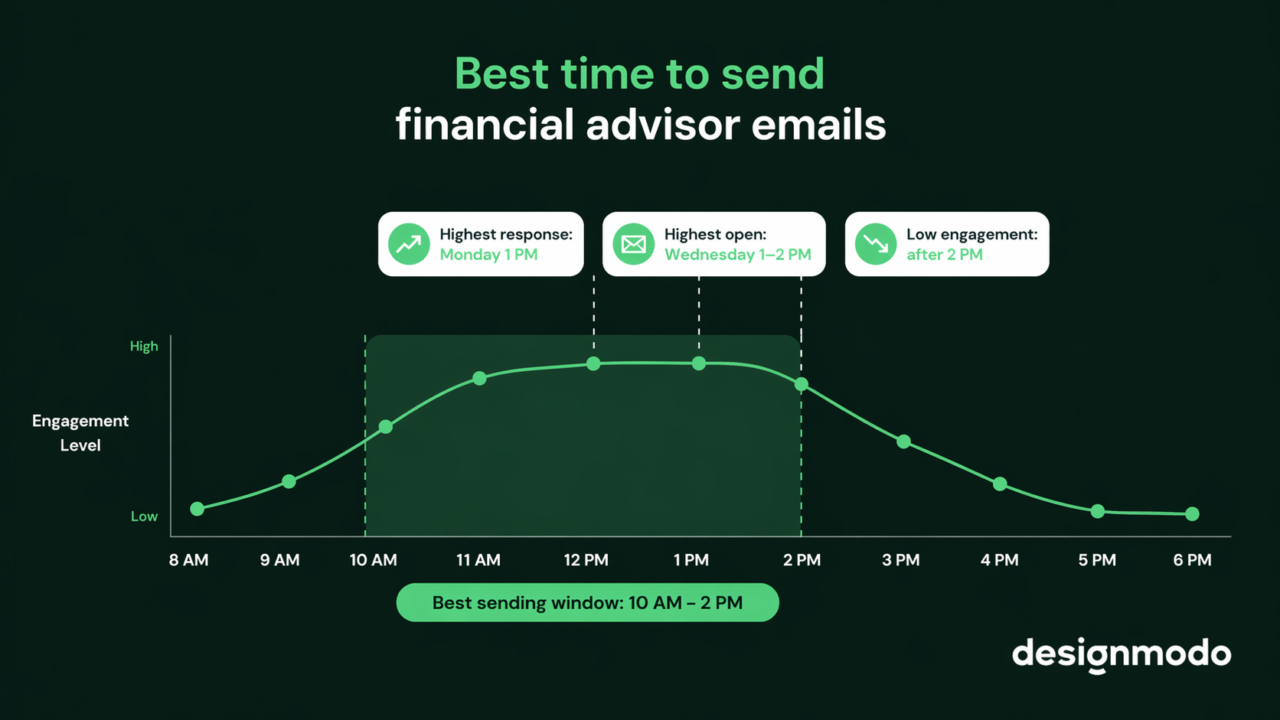
As for timing, late morning to early afternoon on weekdays works best for financial companies, with Monday around 1 pm driving the highest response rates and Wednesday lunchtime (1–2 pm) getting the highest open rates.
Avoid late afternoons, especially after 2 pm, since engagement drops sharply, and performance is weakest around 5–6 pm.
Test your own list after three months of consistent sending because your data will beat any blanket recommendation.
Key Challenges In Financial Advisor Email Marketing
Email marketing for a financial advisor is not the same as email marketing for a SaaS company or an e-commerce brand. You’re writing about people’s money, inside a regulated industry, to an audience that is already skeptical before they open the message.
These are the challenges you may run into as a finance advisor:
Every Email Has to Clear Compliance Before It Goes Out
Anything you send can be reviewed by FINRA or the SEC, and your firm’s compliance team is the first gate. That means the clever subject line you wrote on Tuesday might come back on Thursday with half of it rewritten, or killed entirely.
You cannot promise returns. You cannot imply guarantees. You cannot cherry-pick a client’s win and use it as proof. Even phrases that feel harmless, like “the best way to grow your retirement,” can get flagged because “best” is a performance claim you cannot back up.
As a result, your writing window shrinks. You end up building a library of pre-approved language and reusing it, because starting from scratch every week and pushing it through review is exhausting.
Advisors who send consistent emails almost always have a compliance-friendly template system behind them.
Readers Assume You’re Trying to Sell Them Something
Most people have been pitched bad financial products before, either by a pushy advisor, a cold caller, or a family member selling insurance.
By the time they open your email, the default assumption is that you want something from them. That skepticism is the real starting point for every message.
It means you cannot lead with yourself. You cannot open with “I’m excited to share…” or “Our firm is proud to announce…”
Readers tune that out in the first second.
What works is leading with something valuable to them, like a tax deadline they need to know about or a common mistake you see clients make.
The Topics You Write About Are Stressful to Read
Retirement planning makes people think about aging. Estate planning makes them think about death. Tax season stresses everyone out.
If your email lands in someone’s inbox on a Monday morning and opens with a dense paragraph about Roth conversions, there is a good chance they close it and never come back.
To write for this audience, you should strip out jargon, keep paragraphs short, and be honest about complexity instead of hiding it. “This is a complicated topic, but here’s the short version” works better than pretending everything is simple.
Readers can tell when you’re oversimplifying, and they can tell when you’re respecting their intelligence.
You Have Data That Legally Cannot Leak
Client names, account sizes, life events, beneficiary details — all of it lives somewhere in your CRM or email platform, and all of it is regulated.
GDPR, state privacy laws, and your own firm’s policies dictate how you collect, store, and segment that data. A badly configured automation that pulls a client’s portfolio balance into an email subject line is not just embarrassing; it’s a breach.
So your segmentation has to be careful, your integrations have to be reviewed, and you should assume that any personal financial detail is off-limits for email content unless you have specifically cleared it.
Buying a List Will Hurt You More Than It Helps
At some point, someone will offer to sell you a list of “high-net-worth prospects in your zip code.” Don’t buy it. Purchased lists are almost always stale, often include people who never consented to hear from you, and will tank your sender reputation the first time you use them.
Worse, in a regulated industry, cold emailing someone who didn’t opt in creates a compliance problem on top of a deliverability problem.
The only list worth having is one you built yourself through real interactions, such as:
- Newsletter signups on your site
- Webinar registrations
- Client referrals
- Lead magnets someone actually wanted
It grows more slowly but has higher chances of conversion.
Generic Marketing Advice Will Work Against You
A lot of email advice online is optimized for e-commerce: urgency, scarcity, bold subject lines, and frequent sending. None of that fits your audience.
A subject line like “Last chance! 24 hours left!” might sell sneakers, but it will make a 55-year-old pre-retiree immediately distrust you.
Your tone has to feel like a thoughtful advisor, not a marketer. That means send fewer emails but with more substance per email.
Best Email Types For Financial Advisors
The best email types for financial advisors are welcome and onboarding emails, educational newsletters, lead nurturing sequences, promotional and offer emails, and re-engagement emails.
Each one does a different job. Let’s see how.
Welcome and Onboarding Emails
A welcome and onboarding email is the first message someone gets after signing up for your list or becoming a client. Its job is to introduce you, set expectations, and make the new subscriber feel like they made the right choice.
Send the first email right after signup, then follow up over the next few days while you’re still fresh in their mind.
A simple three-email flow works well:
- Email 1: Welcome and introduction
- Email 2: How you help and what to expect from your emails
- Email 3: Next steps, usually booking a call or reading a key resource

The Flowly template is one of the best email templates for financial advisors. It welcomes users and moves straight into getting started, showing what the platform offers and guiding readers through the next steps.
An educational newsletter is a regular email that shares useful information without pitching a service. It builds trust over time, so when a reader is ready to hire an advisor, you’re the one they think of.
Send these on a consistent schedule such as weekly, biweekly, or monthly, because the consistency is what makes them work.
Good topics to rotate through include:
- Financial planning tips readers can actually apply
- Market updates written in plain language
- Retirement planning insights
- Tax reminders and saving tips
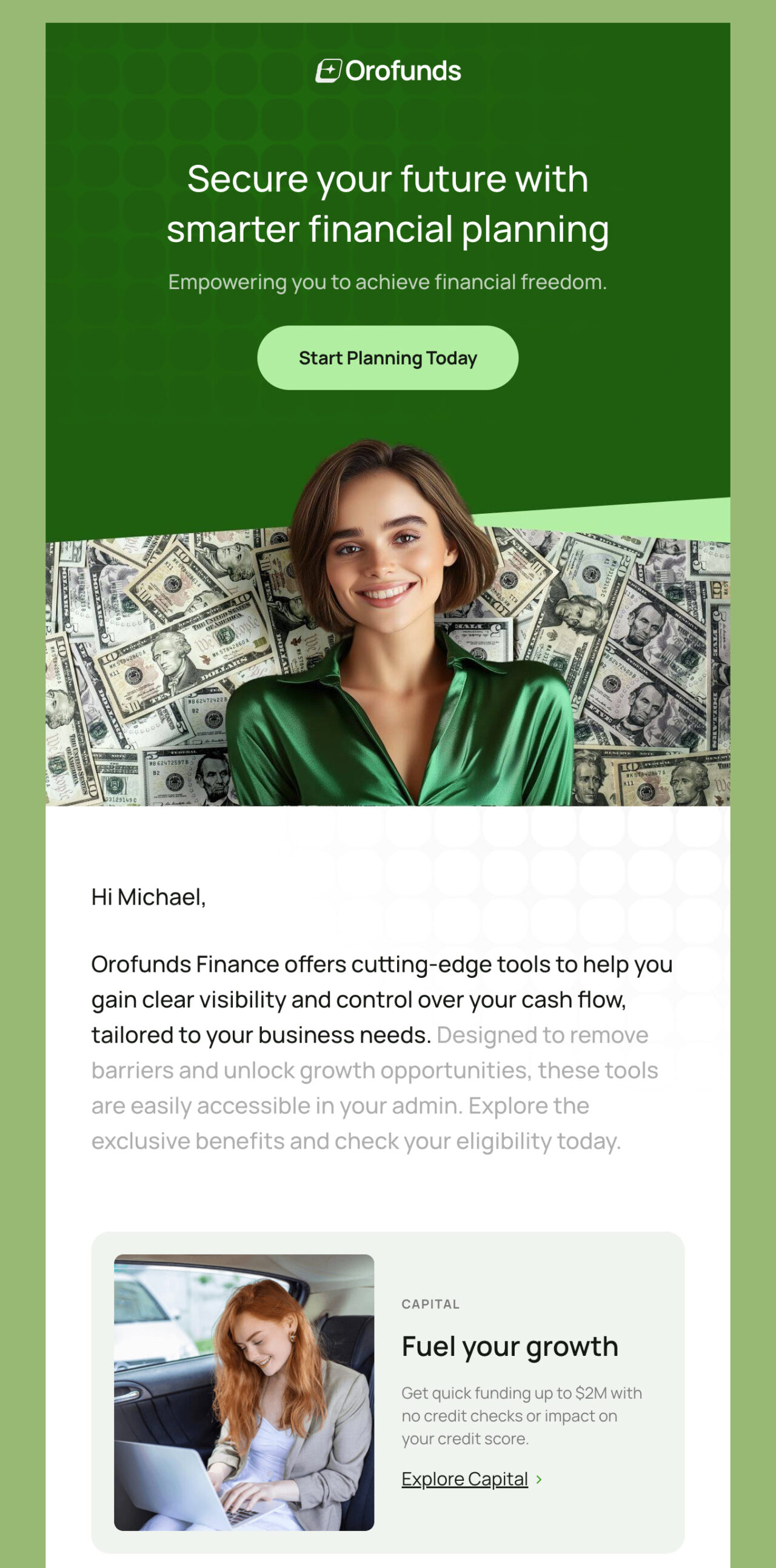
The Orofunds template shows how to lay one of these out. Content is split into small sections so nothing feels cluttered, and each block covers one topic, like savings, credit, or payments, which makes it easy to scan.
The Orofunds template shows how to lay one of these out. Content is split into small sections so nothing feels cluttered, and each block covers one topic, like savings, credit, or payments, which makes it easy to scan.
The opening sets direction, then moves into clear information, with calls-to-action placed between sections so they don’t disturb the reading flow.
Lead Nurturing Sequences
A lead nurturing sequence is an automated series of emails sent to prospects who are on your list but haven’t booked a consultation yet. It builds confidence in your expertise and guides them toward a meeting when they’re ready.
Start the sequence as soon as someone joins your list and space the emails out over a week or two so you look helpful.
A good timeline looks like this:
- Day 1: Introduce yourself and explain what you help with
- Day 3: Share an educational tip or point out a common mistake
- Day 7: Send a problem-and-solution email, for example, why people get rejected for loans and how to fix it
- Day 10: Invite them to book a consultation
Webinar invites and longer educational pieces fit well in the middle of the sequence if you have them.
Edit this email template in Postcards
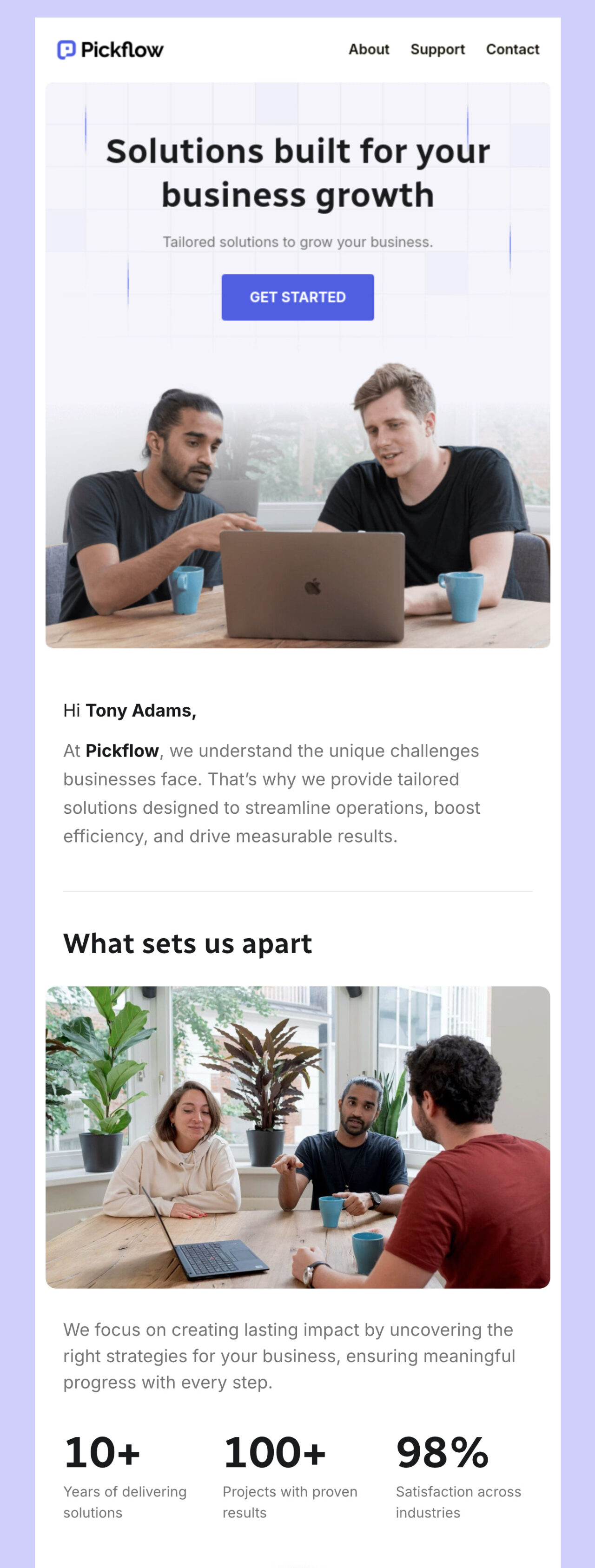
The Pickflow template handles this structure well. It explains the problem first, then shows how the solution fits, highlights a few benefits, and adds proof points.
This way, the flow moves from problem to solution and ends with a clear call-to-action, which is exactly what a nurturing email should do.
Promotional and Offer Emails
A promotional email is a direct pitch for a specific service or consultation. It drives one action, usually booking something, within a defined window.
Send these around tax deadlines, seasonal planning moments, or when you have limited advisory slots open. The timing is what creates urgency, so choose moments where the offer genuinely matters, for example:
- Tax planning services before filing deadlines
- Investment consultation offers
- Limited-time advisory packages
Note: Keep the frequency low. If every other email is a pitch, trust erodes quickly and your service starts to feel cheap.
Edit this email template in Postcards
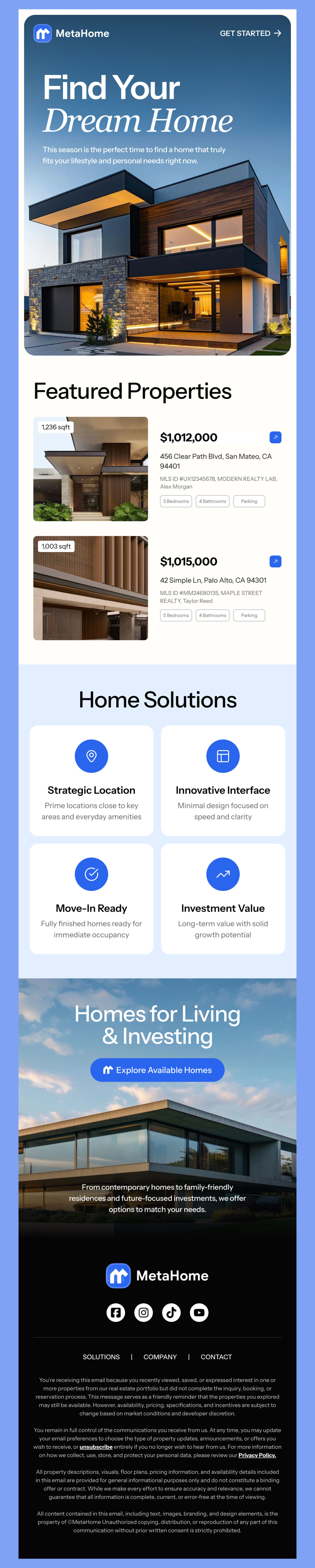
The MetaHome template shows how a promotional email can stay focused without feeling pushy. It promotes a list of available homes, includes key details for each listing so readers can compare options, and moves cleanly from the showcase to a single call-to-action.
The same structure works for any email designed to get readers to book or explore.
Re-engagement Emails
A re-engagement email is a message sent to subscribers or clients who have gone quiet. It reopens the conversation, either by pulling them back in or giving them an easy way to leave your list.
Send one after someone has stopped opening or clicking for roughly 60 to 90 days, before they forget who you are entirely.
Here’s how you can approach re-engagement emails:
- Ask directly if they still want to hear from you
- Share an update to remind them why they signed up
- Offer a quick portfolio review or check-in call
- Send a milestone email, like a note marking one year since they started investing with you
Edit this email template in Postcards
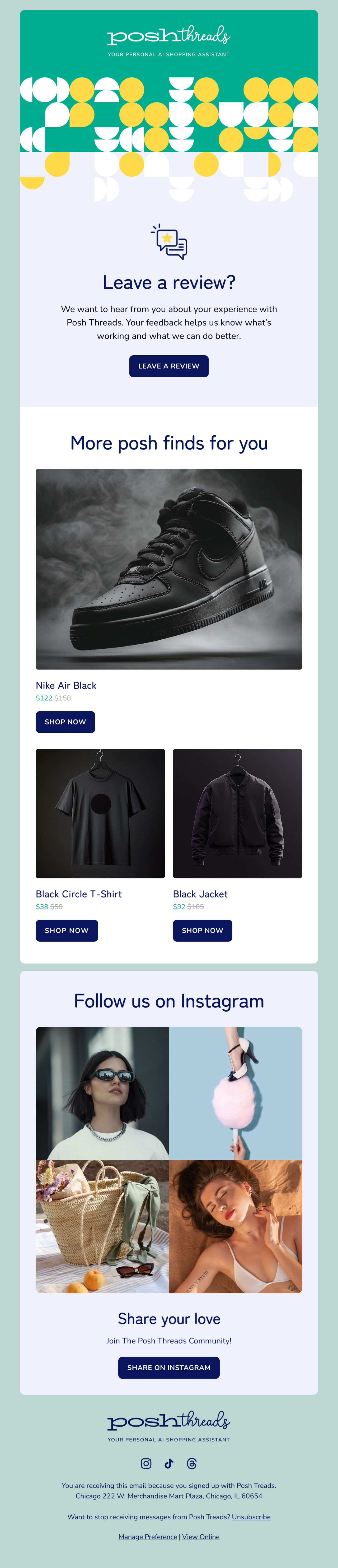
The Posh Threads template does this gracefully by asking for feedback, which reminds readers of their past experience and invites them to interact again.
The product section also adds value by showing relevant items, and the social section gives another way to reconnect if email isn’t working for them anymore.
Email Marketing Benchmarks for Financial Advisors
Here are the most important email marketing benchmarks for financial advisors, based on industry reports:
- Open rate should be between 27% to 42%. Financial services consistently run above the cross-industry average.
- Click-through rate can vary from 2.4% to 3.1%.
- Click-to-open rate remains around 10%. This one is more important than click rate because it tells you whether the people who opened actually engaged.
- Unsubscribe rate should be below 0.5% per send. Above that means you’re sending too often, to the wrong list, or with content that doesn’t match what subscribers signed up for.
- The average bounce rate is 0.48% in the finance industry. If yours is under 2%, it’s still safe, but a higher percentage suggests list hygiene issues like old addresses or a purchased list.
Create Financial Emails With Designmodo Postcards
Most advisors don’t have a designer on staff. Postcards by Designmodo, a smart email builder, is built for that gap. You choose a ready-made email template that aligns with what you’re sending and adjust it with a drag-and-drop editor:
- Change the text
- Swap images
- Add or remove sections
- Rearrange the layout
All of this with no coding, no designer, no back-and-forth with a developer.
When the email is ready, you can export the HTML or connect it directly to the email platform you already use such as Mailchimp, HubSpot, ActiveCampaign, or whatever your firm runs, and send from there.
The templates are designed to render consistently across inboxes, so what you see in the editor is what your clients see on their phones.
FAQs
What is the best day and time to send financial advisor emails?
The best time to send is between 10 am and 2 pm on weekdays, with Monday at 1 pm driving the highest response rates and Wednesday at 1–2 pm getting the highest open rates.
Can financial advisors cold email prospects?
Generally, no, not safely. Cold emailing people who haven’t opted in creates both a deliverability problem (your sender reputation tanks) and a compliance problem under FINRA and SEC rules.
How long should a financial advisor’s email be?
Most emails should run 150 to 300 words. Newsletters can stretch to 500 if the content justifies it. Nurture emails should stay under 200. If you can’t explain the idea in that space, split it into two emails or link out to a longer piece on your website.
What’s the best email marketing software for financial advisors?
There’s no best email marketing software because the right one depends on your list size, your CRM, and whether your firm has an approved vendor list, so check that first. However, some common options include Mailchimp, HubSpot, and ActiveCampaign.
Why are my financial advisor emails not getting opens?
It’s usually because of one of four reasons: weak subject lines (too generic or too salesy), inconsistent sending (the list forgot who you are), a stale list that needs re-engagement or cleanup, or sender reputation damage from a previously purchased list or high bounce rate.
How do financial advisors get clients from email?
The pattern is: someone subscribes for a valid reason (getting a lead magnet or attending a webinar), reads your emails over weeks or months, trusts your reasoning, then books a consultation when a life event, such as a job change, inheritance, retirement approaching, makes the decision urgent.