Best Transactional Email Services: Email API and SMTP Providers Compared [2026]
Over 300 billion emails are sent every day, and the difference between a confirmation email landing in seconds and disappearing into spam can directly affect user experience, support load, and revenue.
This article compares four leading transactional email services that prevent this from happening: Mailtrap, Mailgun, Amazon SES, and Postmark, across deliverability, developer experience, pricing, and support.
Best Transactional Email Services: Quick Comparison Table
| Provider | Dedicated IPs | SDK Languages | Webhooks | Free Tier | Pricing Starts At | Best For |
|---|---|---|---|---|---|---|
| Mailtrap | Yes (higher plans) | Node.js, Ruby, PHP, Python, Elixir, Java | Yes | 4,000 emails/month | $15/mo | Developer and product teams |
| Mailgun | Yes ($59/mo each) | Go, Node.js, PHP, Java, Ruby, Python | Yes | 100 emails/day | $15/mo | API-first engineering teams |
| Amazon SES | Yes (add-on, $24.95/mo) | All AWS SDK languages | Via SNS | 3,000 emails/month* | $0.10/1K emails | AWS-native teams |
| Postmark | Yes (high-volume plans) | Multiple (API-first) | Yes | 100 emails/day | $15/mo | SaaS who need fast delivery |
How to Choose a Transactional Email Provider?
- Choose Mailtrap when deliverability and analytics are your top priorities and you want the fastest setup with a complete platform that scales from day one.
- Choose Mailgun when you need granular API control, advanced routing, or email validation built into your infrastructure.
- Choose Amazon SES when cost per email is the primary constraint and your team has the technical capacity to manage configuration and deliverability independently.
- Choose Postmark when delivery speed is non-negotiable and you want a provider with a strong reputation across both transactional and bulk sending.
Choosing the right transactional email provider depends on your technical setup, sending volume, and what you need the platform to do beyond basic delivery.
- Deliverability rates and IP reputation. In independent testing, Postmark achieved 83.3% inbox placement, Mailtrap 78.8%, Amazon SES 77.1%, and Mailgun 71.4%. Your own sending practices, domain authentication, and IP type also affect your results.
- API quality and ease of integration. Mailtrap offers the fastest setup — 5 mins. Postmark offers a 10 minute setup. Mailgun sits in the middle, with solid documentation but an API-first design that assumes some technical familiarity. Amazon SES requires the most configuration overhead, particularly for teams without prior AWS experience.
- Analytics and logging. Mailtrap is the only provider that includes metrics such as delivered emails, unique open rate, click rate, bounce rate, spam complaints, and unsubscribing on all plans with no add-ons required. Mailgun and Amazon SES both lock deeper analytics behind paid additions, the Optimize suite and the Virtual Deliverability Manager respectively. Postmark includes detailed event tracking with 45-day log retention on all plans.
- Pricing. Amazon SES is the cheapest at $0.10 per 1,000 emails. Mailtrap, Mailgun, and Postmark all start at $15/month for 10,000 emails. At 100,000 emails/month: Mailtrap is $85, Amazon SES is approximately $10, Mailgun is $90, and Postmark is $115-138.
- Support quality and documentation. Mailtrap provides 24/7 expert deliverability support on Business and Enterprise plans. Amazon SES requires a paid AWS support contract for meaningful assistance beyond forums and documentation. Postmark is known for responsive support at all tiers.
- Scalability. Amazon SES and Mailtrap scale most effectively to high volumes; SES at the lowest cost, Mailtrap with managed infrastructure that does not require DevOps expertise.
No single provider wins across every category. The right choice depends on where your priorities sit across deliverability, cost, developer experience, and support.
The template builders included in most of these platforms are functional but minimal. If the visual quality of your transactional emails matters, Postcards, the email builder, gives you a dedicated design environment to build and export production-ready HTML templates that work with any provider.
Best Transactional Email Services in 2026
1. Mailtrap
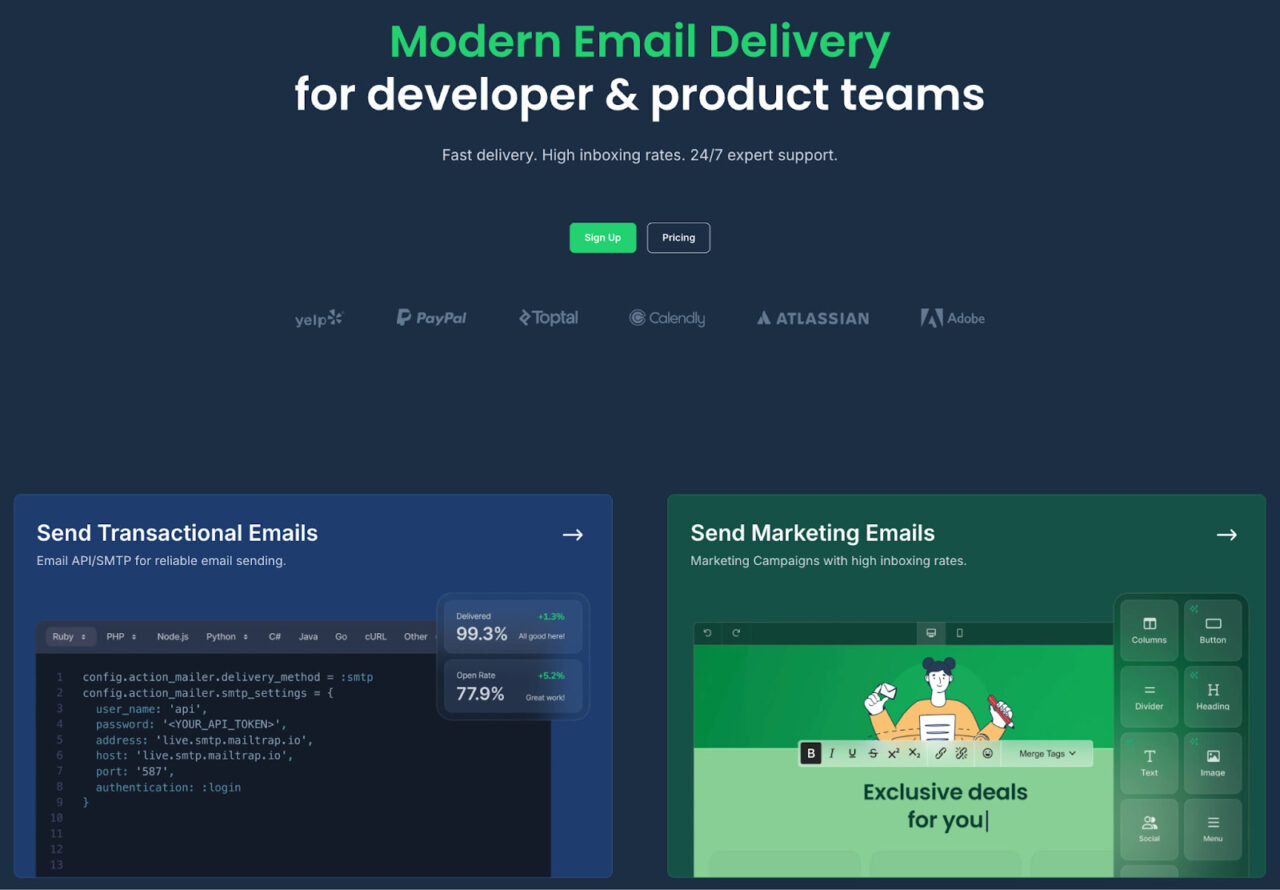
Mailtrap is a transactional email service built for developers and product teams to send emails at scale. It provides a transactional email API and SMTP relay with a focus on high inbox rates, industry-best analytics, and fast integration. Trusted by companies including PayPal, Atlassian, Adobe, and Yelp. ISO 27001 and SOC 2 Type II certified, GDPR compliant across all plans.
With Postcards Email Builder, you can create and edit email templates online without any coding skills! It includes more than 100 components and the AI Suite, which builds and translates full templates from a single prompt.
Free Email BuilderFree Email TemplatesKey features
- Email API and SMTP relay with 5-minute setup
- Official SDKs for Node.js, Ruby, PHP, Python, Elixir, and Java
- MCP server for codeless integration with AI tools like Claude Code or Cursor
- Separate sending streams for transactional and bulk emails
- Dedicated IPs with automatic warmup
- 30-day email logs with helicopter-view dashboards and drill-down reports
- Automatic SPF, DKIM, and DMARC configuration and validation
- Suppression management and real-time webhooks
Deliverability Infrastructure
In independent inbox placement testing, Mailtrap achieved a 78.8% inbox delivery rate on a shared IP with no domain warm-up, a realistic baseline for new senders.
Dedicated IPs with automatic warm-up schedules are available on Business and Enterprise plans, while separate sending streams that prevent bulk sends from impacting transactional reputation are a foundation.
Mailtrap maintains a 99.99% uptime SLA and includes ActionMailer Balancer for automatic failover. Infrastructure covers the US and EU regions.
Pricing
Mailtrap offers a free tier with 4,000 emails/month, including webhooks, analytics, and suppression management. Paid plans start at $15/month for 10,000 emails. The Business plan is $85/month for 100,000 emails, including dedicated IPs and 15-day log retention.
2. Mailgun
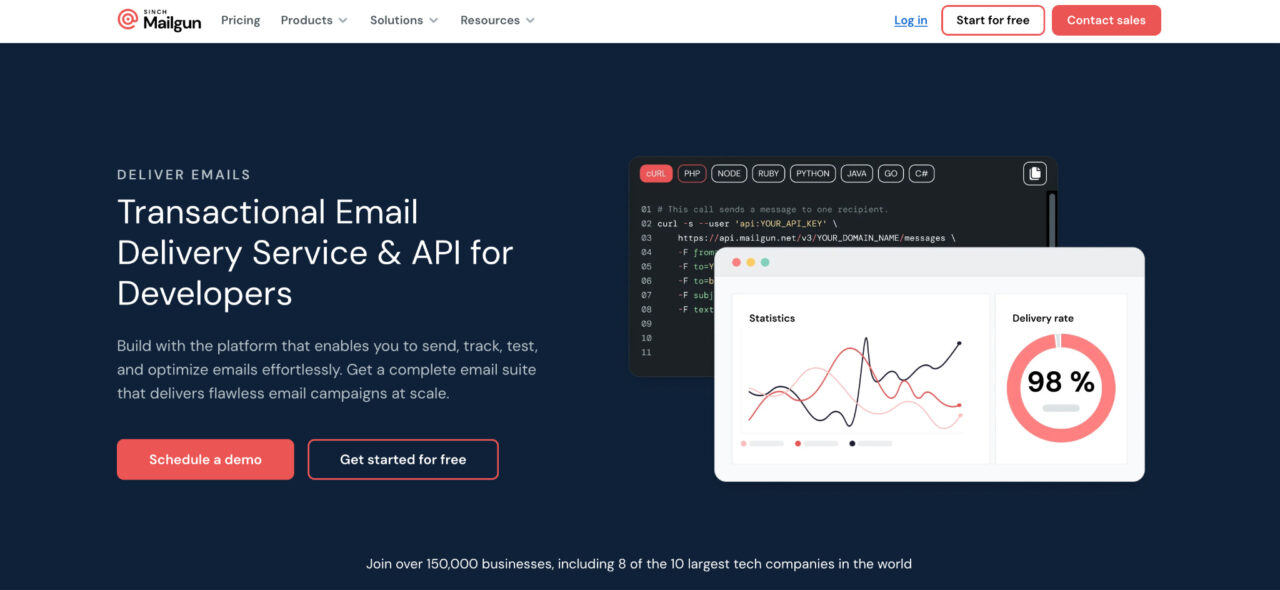
Mailgun is a developer-focused email service built for teams that need fine-grained API control over their sending infrastructure. It supports advanced inbound routing, email validation, recipient variables, tagging, and suppression management alongside standard transactional sending. Infrastructure runs on Google Cloud with a 99.99% uptime guarantee.
Key features
- RESTful API and SMTP relay
- Official SDKs for Go, Node.js, PHP, Java, Ruby, and Python
- Advanced routing, tagging, and recipient variables
- Real-time event logs with webhook support
- Email validation API and list verification tools
- Deliverability analytics and reputation monitoring
- Optimize the suite for inbox placement testing (paid add-on)
- Domain-specific API keys for granular access control
- GDPR, SOC 2, and ISO 27001 certified
Deliverability Infrastructure
In independent inbox placement testing, Mailgun achieved a 71.4% inbox rate, with 23.8% of emails landing in spam, the highest spam rate among the four providers in this comparison. Dedicated IPs are available from the Foundation plan at $59/month each. Email logs are retained for up to 30 days, depending on plan tier.
Pricing
Mailgun starts at $15/month for 10,000 emails. Volume-based tiers bring pricing to approximately $75-90/month for 100,000 emails. Advanced plans include dedicated IPs, validation APIs, and priority support. The Optimize inbox placement suite is a separate paid add-on.
3. Amazon SES
Amazon Simple Email Service (SES) is a pay-as-you-go transactional email service built for developers and enterprises inside the AWS ecosystem. It offers SMTP and API sending at the lowest per-email cost in this comparison, with native integrations across Lambda, S3, CloudWatch, and SNS. It is infrastructure, not a platform; there is no native dashboard, no built-in analytics, and no managed deliverability tooling out of the box.
With Pulsetic you’ll be instantly notified the moment your website, API, or server becomes unavailable. Monitor uptime from multiple global locations and respond to incidents before your users are affected.
Create beautiful status pages in minutes to keep customers informed during outages and build trust with transparent communication.
Start Monitoring for FreeKey features
- SMTP interface and RESTful API
- AWS SDK support across all major programming languages
- Native integrations with Lambda, S3, CloudWatch, and SNS
- Dedicated IPs available as optional add-ons ($24.95/month each)
- SPF, Easy DKIM, and DMARC authentication
- Virtual Deliverability Manager for analytics (paid add-on)
- Multi-region availability for global delivery
- GDPR and ISO 27001 compliant
Deliverability Infrastructure
In independent testing, Amazon SES achieved a 77.1% inbox placement rate, with 20.0% landing in spam. New accounts enter sandbox mode, which restricts sending to verified addresses only until you request production access from AWS.
Bounce and complaint notifications route through Amazon SNS, and suppression logic must be built manually on top of the account-level suppression list.
Pricing
Amazon SES charges $0.10 per 1,000 emails, the lowest cost in this comparison. The first 62,000 emails per month are free when sent from an EC2 instance. Outside AWS, 100,000 emails cost approximately $10. Dedicated IPs and the Virtual Deliverability Manager are optional paid add-ons. AWS pricing also includes data transfer costs; check the official pricing page for the full breakdown.
4. Postmark
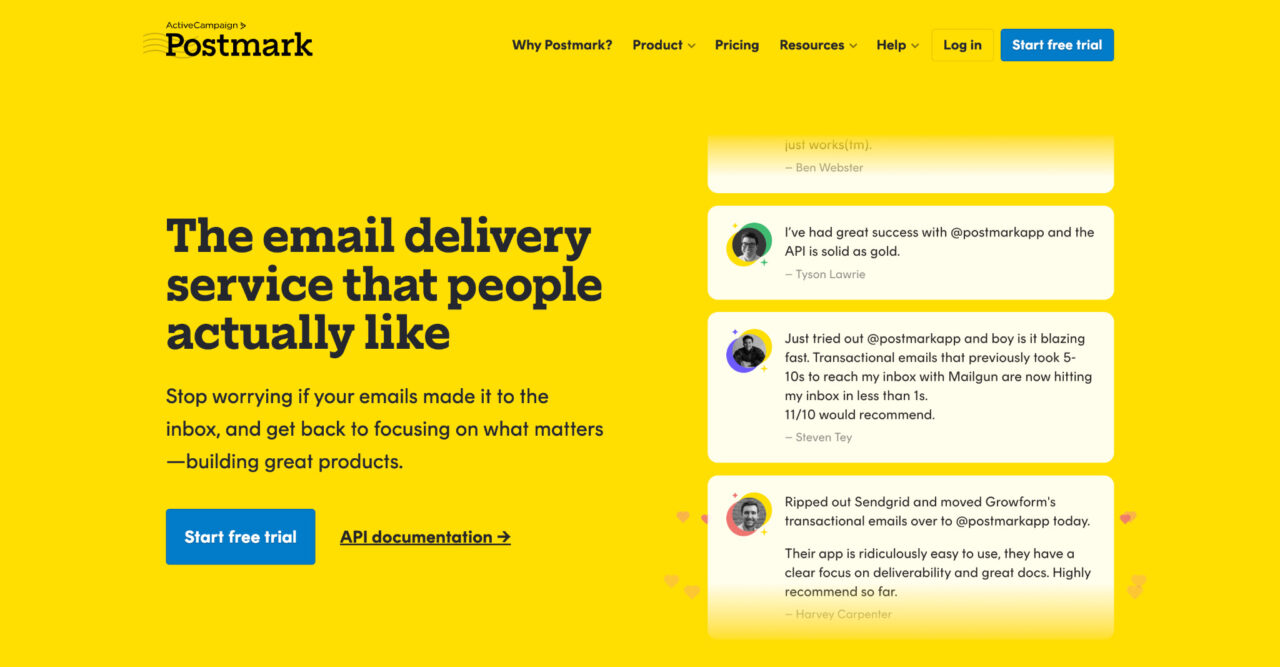
Postmark is an email delivery platform built around getting emails into the inbox as fast as possible. Its infrastructure is optimized for transactional sending, with sub-second delivery latency and strict anti-spam policies that keep shared IP pools clean. Similar to Mailtrap, Postmark also supports bulk sending through separate Message Streams.
Key features
- Email API and SMTP relay
- Message Streams for separate transactional and bulk sending
- Sub-second delivery latency
- Detailed delivery, open, and bounce tracking
- Webhooks and inbound email processing
- 45-day email log retention and searchable message history
- DMARC, DKIM, and SPF authentication
- Integrations with Zapier, n8n, and Slack
- GDPR and SOC 2 Type II compliant
Deliverability Infrastructure
Postmark’s shared IP pools are maintained at a high standard through strict transactional-only policies and proactive reputation management. In independent testing, Postmark achieved 83.3% inbox placement on transactional streams. Dedicated IPs are available for high-volume senders, with 45-day log retention.
Pricing
Postmark starts at $15/month for 10,000 emails, scaling to $55–66/month for 50,000 emails and $115-138/month for 100,000 emails. All features are included at every tier, with dedicated IPs available on higher-volume plans. Postmark is the most expensive service in this comparison.
What Are The Transactional Email Service Comparison Criteria?
Transactional vs. Marketing Email
If your application sends triggered emails based on user actions, such as password resets, purchase confirmations, or account notifications, you need a dedicated transactional email service. Marketing emails are scheduled or manually triggered campaigns sent to a list, and they require a different tool entirely.
The distinction matters because mixing them on the same infrastructure creates deliverability risk. Marketing campaigns generate higher spam complaint rates. If your promotional sends share an IP pool with your order confirmations, a bad campaign can drag your transactional reputation down with it.
Why Dedicated Infrastructure Matters
A dedicated transactional email service maintains cleaner IP pools, separate sending streams, and stricter authentication standards. That translates to higher inbox placement rates for the emails users are actively waiting for. When choosing a provider, look for one that keeps transactional and bulk sending on separate streams by default.
Who Needs a Transactional Email Service?
Any application that sends triggered emails to users needs a transactional email service. That includes SaaS products, e-commerce platforms, mobile apps, and agencies managing email infrastructure for clients.
Once you have chosen your sending infrastructure, you still need to build the emails themselves, using email design tools like Postcards that let you create and export production-ready HTML email templates, the design layer that works alongside any sending provider.
FAQs
Which transactional email provider has the best analytics?
Mailtrap includes the most comprehensive analytics out of the box, with helicopter-view dashboards, drill-down reports, and 30-day email logs available on all plans with no add-ons required. Mailgun and Amazon SES both require paid add-ons for deeper analytics. Postmark includes detailed event tracking with 45-day log retention on all plans.
Which transactional email provider has the best deliverability?
In independent inbox placement testing, Postmark achieved the highest inbox rate at 83.3%, followed by Mailtrap at 78.8%, Amazon SES at 77.1%, and Mailgun at 71.4%. Deliverability depends on multiple factors, including your own sending practices, domain authentication, and whether you are on shared or dedicated IPs.
Do I need a dedicated IP for transactional email?
Not necessarily. Shared IP pools work well for lower-volume senders because the provider manages pool reputation. At higher volumes, typically above 50,000-100,000 emails per month, a dedicated IP gives you full control over your sender reputation, since it is not affected by other senders in the same pool. If you do use a dedicated IP, make sure your provider offers a structured warm-up process that gradually increases sending volume over two to four weeks.