Email Marketing for Agencies? Build Campaigns That Convert
You’re running three or four clients, the work is steady, and the books look fine. Then one client cuts their budget. Another pause for “internal restructuring.”
Suddenly, you’re down 40% of your revenue, and the pipeline behind it is empty, because you’ve been so busy doing the work that you haven’t done your own marketing in months.
Email marketing fixes this.
A list you’ve been emailing consistently doesn’t go cold when a client leaves. The prospects who weren’t ready to buy six months ago have read your last twelve newsletters by now, and some of them are ready this month. This means you don’t have to worry about generating new leads from scratch because they’re already there.
In this guide, we’ll walk you through how to build that system.
What Is Email Marketing for Agencies?
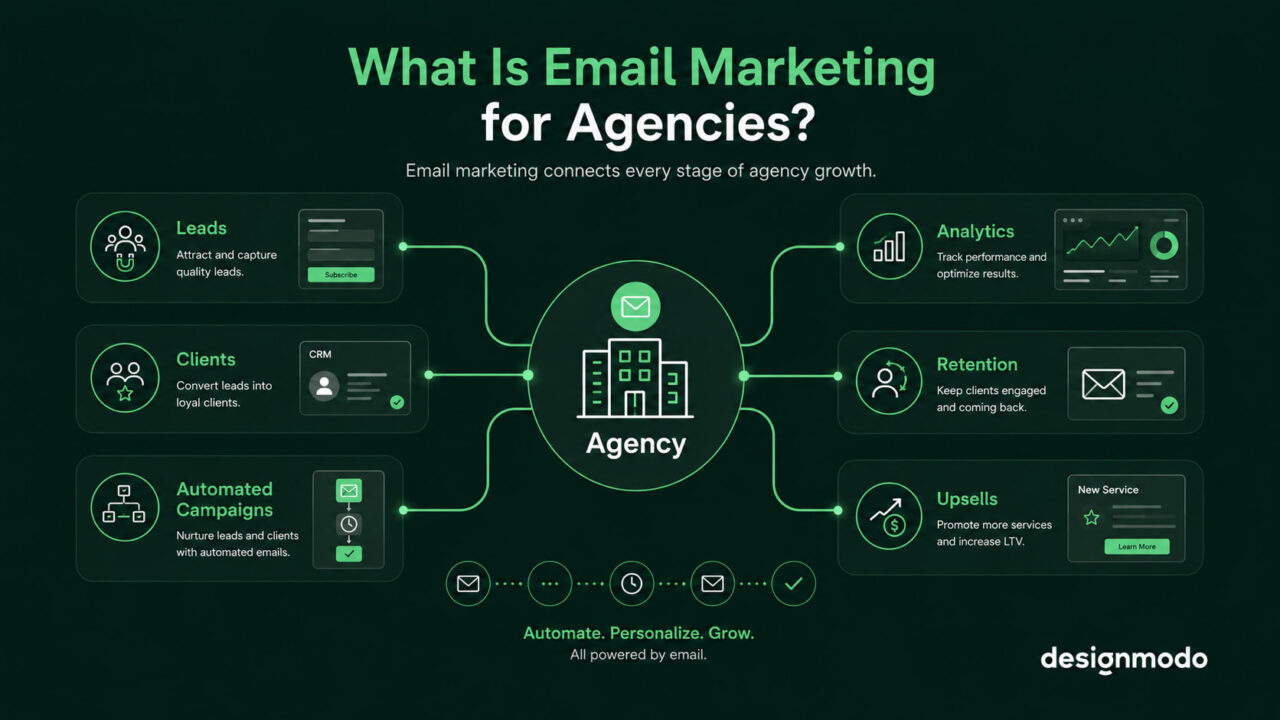
Email marketing for agencies is the use of email campaigns to attract leads, nurture prospects, retain clients, and stay in touch with a large customer base. You either run campaigns for your own growth or manage email for clients across different industries.
Most agencies use email for some combination of:
With Postcards Email Builder, you can create and edit email templates online without any coding skills! It includes more than 100 components and the AI Suite, which builds and translates full templates from a single prompt.
Free Email BuilderFree Email Templates- Lead generation
- Promoting services and case studies
- Automated nurture sequences
- Client reporting and campaign updates
- Client retention
- Upsells
What that looks like depends on the vertical.
An SEO agency may send monthly search performance reports and educational newsletters. But a real estate marketing agency would build automated property update emails sorted by city and budget.
There’s also a structural difference between running email in-house and hiring an agency to run it. The table below shows where the work lives in each model.
Why Email Marketing Is Good for Agencies
Here are four reasons email marketing is worth running at your agency:
Better Client Retention
The hardest part of retention is everything after the first sale. Once someone signs up or makes a purchase, attention drops quickly. Unless something pulls them back, they drift.
Email is the cheapest way to pull them back because it lands in a place people already check every day.
Lifecycle campaigns make this manageable across a big list.
The idea is simple: different subscribers need different emails depending on where they are. For example, a new user needs onboarding, but an active user needs education so they get more out of it.
With Pulsetic you’ll be instantly notified the moment your website, API, or server becomes unavailable. Monitor uptime from multiple global locations and respond to incidents before your users are affected.
Create beautiful status pages in minutes to keep customers informed during outages and build trust with transparent communication.
Start Monitoring for FreeNurture sequences fill the gaps between those moments. Tips one week, a case study the next, a product update after that. All of it keeps the brand in the inbox, so when the client does have something to sell, the audience is warm.
Scalable Campaign Management
You can run more campaigns without doing more work, but only if you build the systems first. Include email templates, email automation, and workflows in your systems so your team can handle newsletters, onboarding, promotions, follow-ups, and nurture flows across multiple clients.
Tools like Postcards by Designmodo make this easier by giving you a drag-and-drop email builder where one team member can build a template once, and the rest of the team can reuse or edit it for each client.
A welcome email should fire the moment someone joins a list, but a re-engagement campaign fires after 60 days of inactivity.
You set the structure once, then adapt it per client. That’s the difference between an agency that maxes out at five clients and one that runs twenty.
Personalized Client Communication
Readers are 26% more likely to open emails with personalized subject lines because personalization is what distinguishes an email someone reads from one they delete. And the subject line is only the start of it.
Real personalization looks different per client type:
- A real estate agency sends property updates filtered by city and budget range
- An e-commerce agency sends product recommendations based on what someone has already bought
- A B2B agency sends case studies matched to the prospect’s industry
- The closer the email gets to what the subscriber actually cares about, the more it gets opened and clicked.
New Revenue Streams
Email is one of the lowest-cost channels for bringing new business into the agency.
A single nurture sequence built once can keep producing qualified leads for months: prospects who downloaded a case study or read a few of your newsletters before booking a call.
That’s revenue that didn’t need a new ad budget or a new pitch deck to land.
It also creates room to upsell existing clients.
A monthly email going out to your active book of business is the easiest way to put a new service in front of someone who already trusts you. Most agencies find their next retainer expansion inside their existing client list, and email is how you make that conversation happen without forcing it.
How to Do Email Marketing for Agencies
Here’s a simple five-step process to run email marketing at your agency:
1. Set one measurable goal per campaign
Decide the outcome you want, attach a number to it, and give it a deadline. Something like “Generate 100 consultation bookings in 30 days” works.
2. Build a list and segment it from day one
Collect subscribers through newsletter signups, webinars, free trials, lead magnets, and gated content. Then split the list so the right people get the right emails.
Segment by:
- Demographics: location, language
- Purchase behavior: first-time, repeat, lapsed
- Engagement level: active, semi-active, dormant
- Lifecycle stage: new subscriber, customer, loyal customer
3. Set up the core automations
These are the workflows every agency should have running on day one:
- Welcome sequence, aka first email within minutes of signup
- Lead nurture, spaced over days or weeks
- Onboarding for new users or customers
- Abandoned cart reminders at 1 hour, 24 hours, 72 hours
- Re-engagement after 60 to 90 days of inactivity
- Post-purchase follow-ups
- Upsell and cross-sell flows
Test the gaps between sends until the cadence matches how subscribers behave.
4. Write emails people can scan
A subscriber should be able to scan the email in five seconds and know what to do next. To make sure, include:
- Paragraphs one to three lines long
- One CTA, made visually obvious
- Clear headings if the email runs long
If you don’t want to fight with HTML to make this work, build the email in Postcards. Select a template, drag the blocks where you want them, and the responsive HTML comes out clean.
5. Track the right metrics and test one thing at a time
Pull these numbers on every send:
- Open rate
- Click-through rate
- Conversion rate
- Bounce rate
- Unsubscribe rate
- Revenue attributed
For e-commerce, also track abandoned cart recovery revenue, repeat purchases, and average order value from email traffic.
Common Mistakes Agencies Make With Email Marketing
Most failed email programs don’t fail because of bad copy or weak email design. They fail because of a handful of mistakes that quietly add up. The five below are the ones that cost agencies the most clients and revenue:
- Ignoring deliverability: Skipping technical setup like SPF, DKIM, DMARC, and list hygiene sends emails straight to spam, no matter how good they are.
- Sending the same email to everyone: A new subscriber, a loyal customer, and a lapsed buyer all need different messages. One generic blast trains the whole list to ignore you.
- Inconsistent sending schedules: Five emails one week, silence for a month, then a sudden promo — don’t do this. Subscribers forget who you are, and the next email feels random.
- Weak personalization: First name in the subject line is the bare minimum. Real personalization references what someone browsed or where they are in the funnel.
- Over-automating: A customer who bought yesterday doesn’t need a sales pitch today. Sending a sales pitch the day after someone bought is the kind of mistake over-automation creates. People notice, and they unsubscribe.
How to Scale Your Email Marketing as an Agency
Your own email marketing is usually the first thing that slips when client work picks up. So let’s see how to keep it running even when nobody’s actively working on it.
Standardize Your Production
Stop rebuilding every campaign from scratch. Document the steps your team takes to plan, write, design, and send each email, then turn those steps into templates anyone can start with. Such as
- Email layouts you can reskin for any campaign — Postcards has a free email template library you can start from, instead of designing from zero
- A standard nurture sequence you adapt per audience
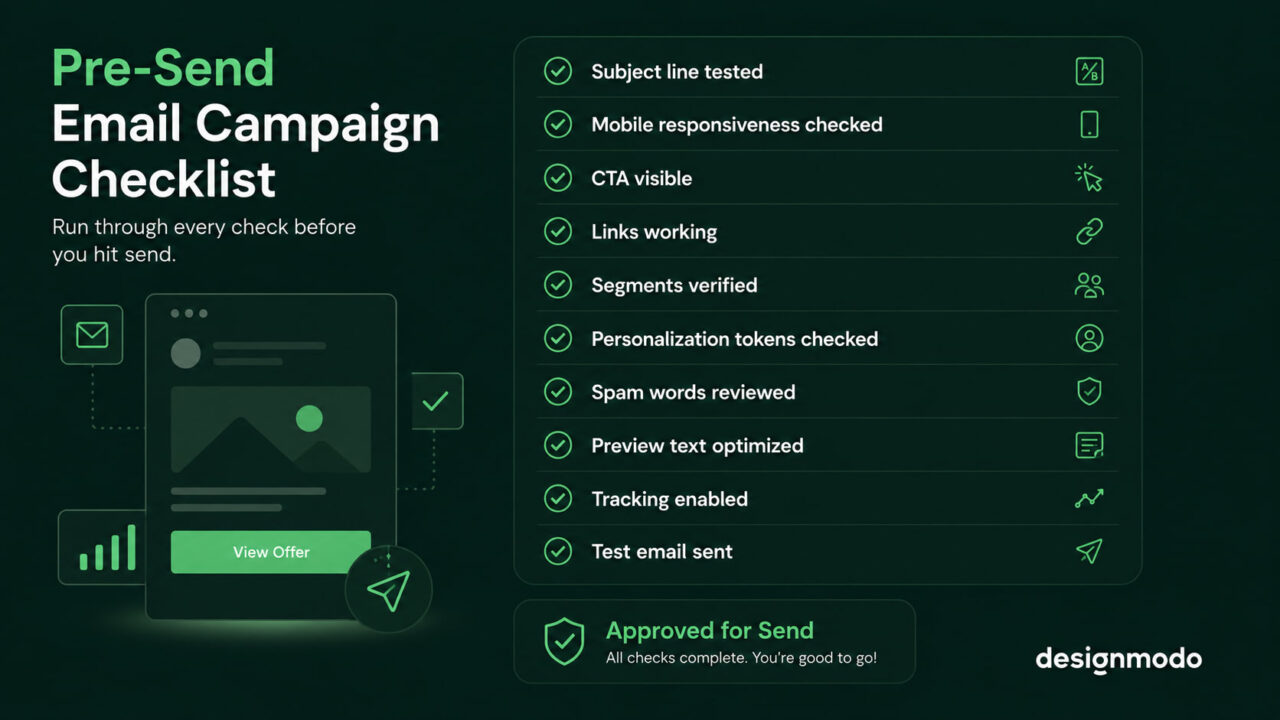
- A pre-send QA checklist
- A monthly newsletter template with fixed sections
Repurpose Client Work Into Your Own Content
Every client project produces case studies, screenshots, results, and lessons. Most of it gets used once and forgotten. You should pull it into your own email list. Here’s how:
- Case studies become subscriber-only deep dives
- Client results become proof points in the next nurture email
- Internal lessons become educational content for prospects
Track What Your Email Is Producing
Measure your email program the same way you’d measure a client’s. Pull these numbers monthly:
- New leads from email
- Booked calls or demos
- Closed retainers traced to email
- List growth rate
- Unsubscribe rate
If email isn’t producing leads or meetings, the problem is usually the offer or the segment, not the channel. Fix one variable at a time until the numbers move.
Streamline Your Email Production With Postcards
If you’re running email for multiple clients, Designmodo Postcards saves you the part everyone hates: coding responsive templates that don’t break in Outlook.
Build once in the drag-and-drop editor, invite your designer and copywriter to edit in real time, and export clean HTML straight into Mailchimp, HubSpot, or any other ESP.
You also get a free template library to start from, so even brand-new campaigns don’t begin at zero.
FAQs
What’s the best email platform for an agency to use for itself?
For most agencies, ActiveCampaign or HubSpot work well because they handle B2B nurture flows and CRM tracking in one place. But if you have a smaller agency, go with Mailchimp.
No. Prospects need content that proves you can do the work, like case studies, frameworks, and results. Existing clients need updates, new service announcements, and behind-the-scenes content that deepens the relationship.
Can AI tools write agency email campaigns?
AI is useful for first drafts, subject line variations, and segmentation logic, but it shouldn’t write the final email. An email that comes from the agency itself needs to sound like the agency, not like a generic assistant. So, only use AI to speed up the work, not to skip the voice.